


Artist Spotlight - "Channeling Beauty, Power, and Meaning"

An interview with celebrated British-Egyptian artist Nazir Tanbouli.
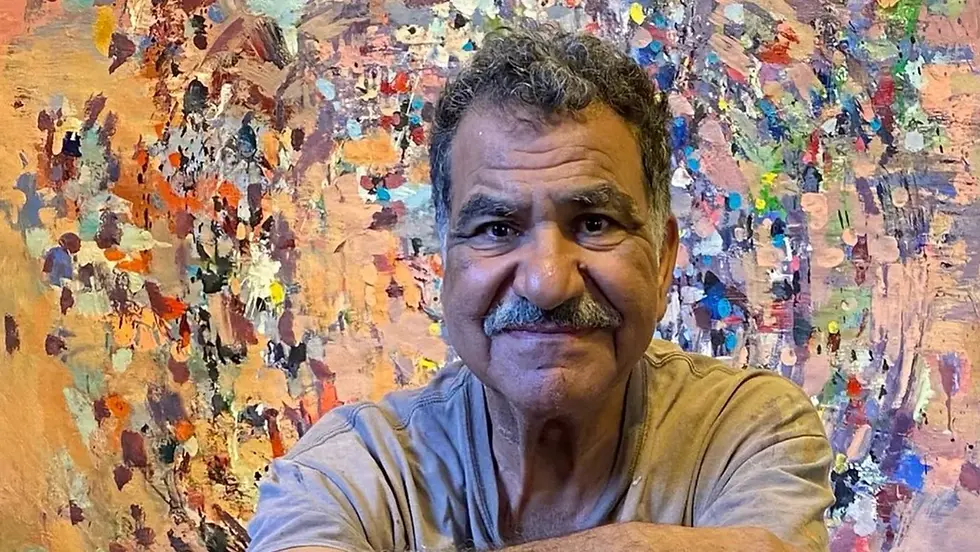
CARAVAN's president, Paul Chandler, had the honor of interviewing the noted British-Egyptian artist Nazir Tanbouli, who is based in Cairo, Egypt, about his personal story, art and spiritual and philosophical perspective on life.
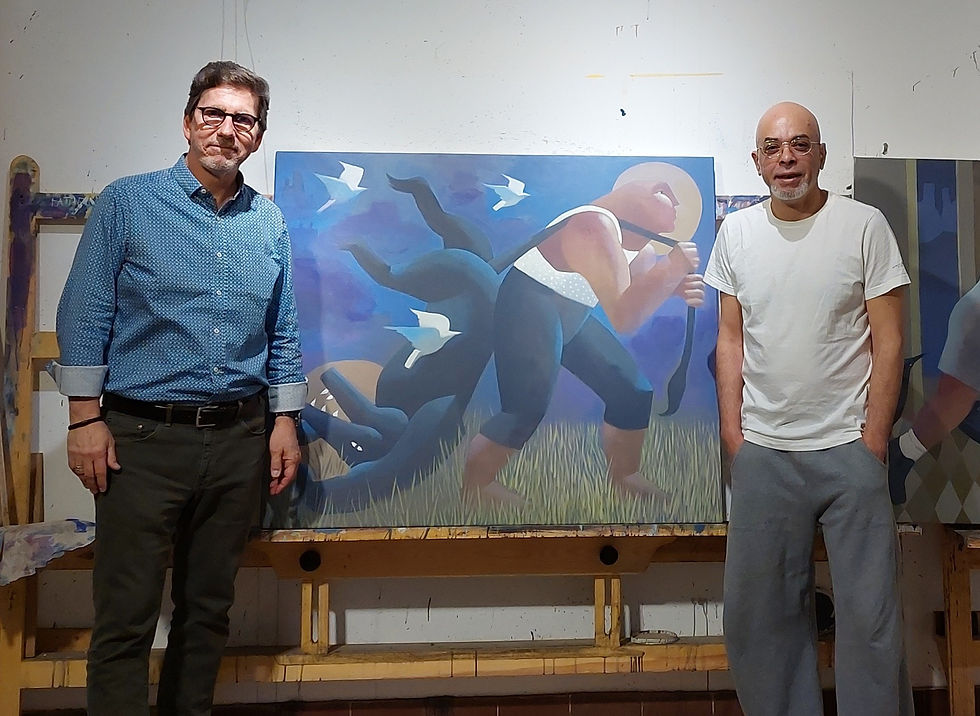
"I feel that an artist is like a doctor or a priest. I have to respond to the needs of society around me."
- Nazir Tanbouli, visual artist
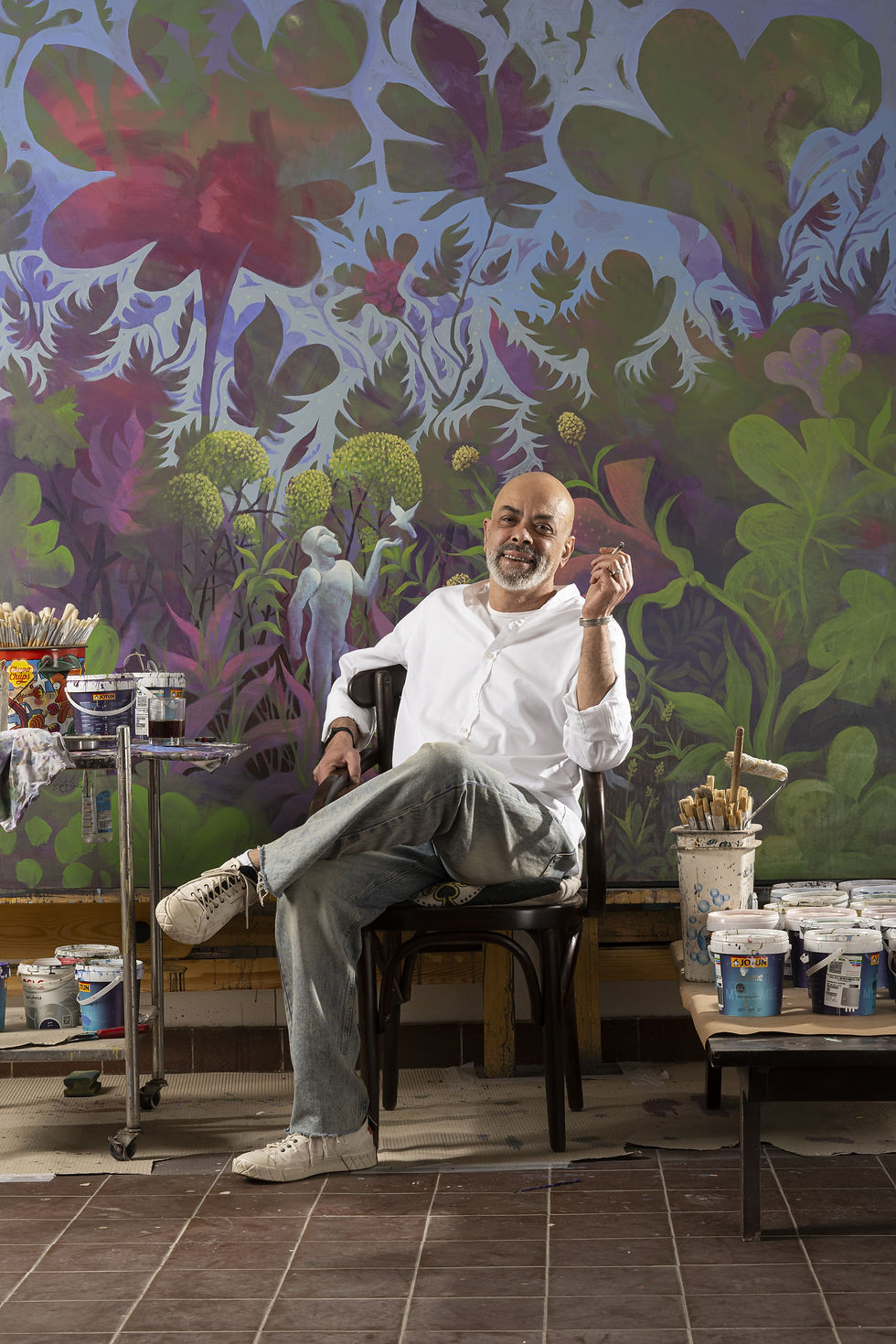
Nazir Tanbouli is a British-Egyptian artist, born in Alexandria, Egypt in 1971, known for his drawing, painting, and large-scale mural work. Tanbouli studied at the University of Alexandria Faculty of Fine Arts and later earned an MA in Fine Art (Printmaking) from Camberwell College of Arts in the UK. Tanbouli’s work is narrative, biographical, and often humorous. He has exhibited in many solo and group exhibitions nationally and internationally, and his work is held in numerous prestigious collections around the world. He lives and works in Cairo, Egypt.
For more information:
-Instagram:@nazirtanbouli
-Website: www.nazirtanbouli.com
_______________________________________________
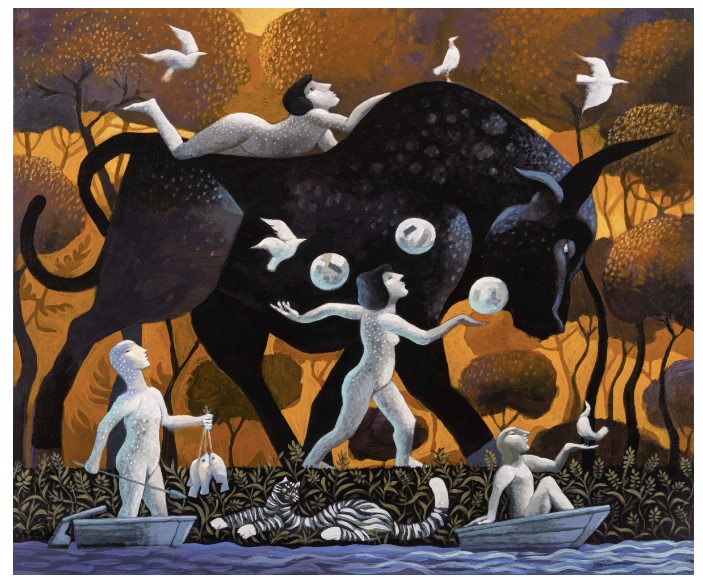
I would love to hear how you became an artist. Can you share how that came about, and who and what most influenced you in your artistic journey?
Nazir: .I was born to Egyptian parents in 1971 in Mogadishu, Somalia. My father was a charity teacher in Somalia. Back in the days of Nasser [President of Egypt from 1954-1970], they used to send like teachers to different African countries. And my dad was a mathematics teacher and he was sent to Somalia. He took the plane to Somalia with my mom, in her wedding dress, on the same day that Nasser died, the 27th of September 1970. And I was born nine months after. Only four months after my birth, I got dangerously ill from polluted water. The care I needed was lacking in Somalia at the time, so my parents brought me to Alexandria to live in my grandparents’ home. I was only five months old. And then they came back and got me when I was five years old. So basically, I grew up with my grandparents as my parents, and my eight uncles as my eight older siblings. That experience affected how I dealt with my family and my real parents for the rest of my life.
I was raised in a neighborhood in Alexandria called Muharram Bek, and it had a high concentration of Christians. Actually, we were the only Muslims in the whole building. These were Coptic Orthodox Christians, so every door had a cross, every room had an icon. I was just a child wandering around and playing on the stairway. And there were three tenants in the building that were priests. It was like living in a church. They were my aunties and uncles and I didn't know any difference. When the priests visited, all the children ran and kissed their hands and I went with them. Later on, I was told me that I wasn’t one of them. This was a big influence on me early on.
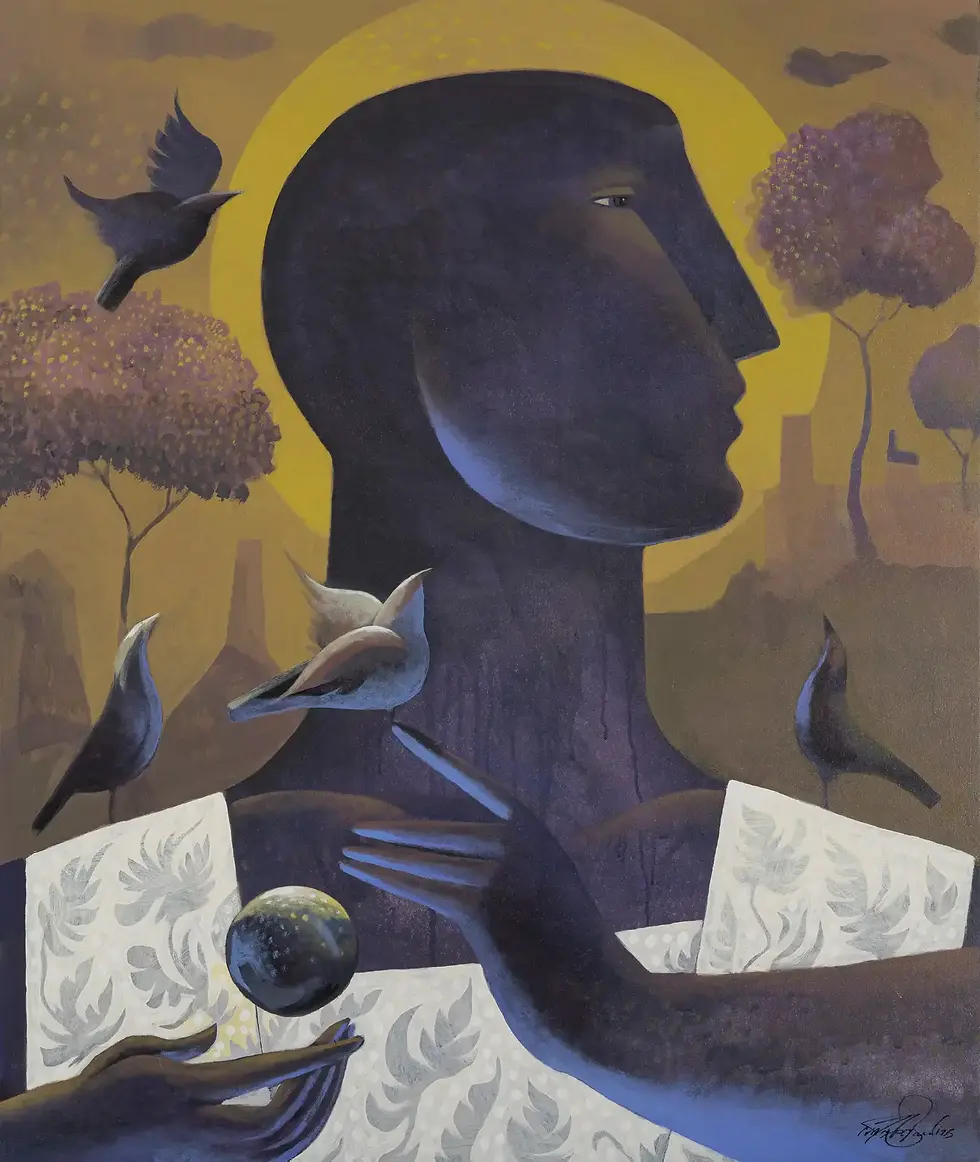
My uncle, who was 16 years older than me at the time, was a young painter in the 1970s, and he was experimenting with abstract styles. That's how I started painting, when I was less than two years old. Painting was a way of playing, rather than picture making.
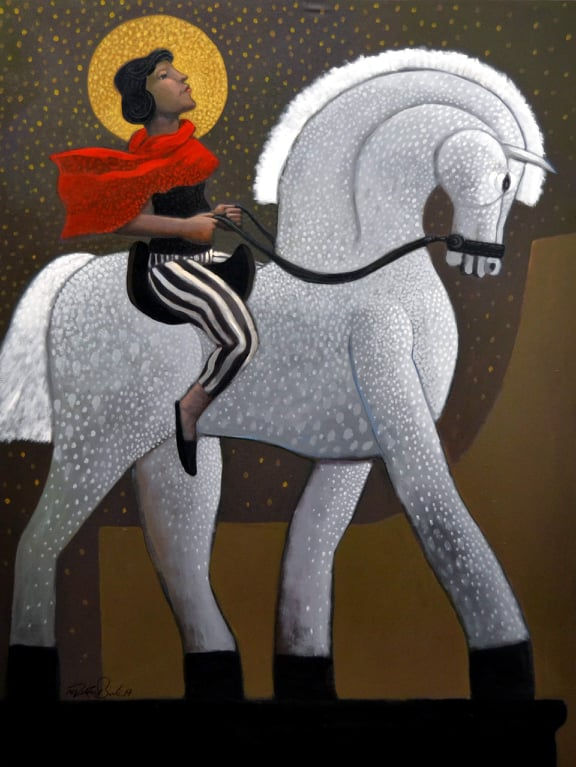
But iconography was the first thing that made me realize that a picture could have a meaning. I was very impressed with icons because they showed action – dragons and horses. An icon wasn't just a picture but it told a story. 35 years later, on the first page of my master thesis which I did in London, I wrote, “You do not need to be a Christian to relate to the pain of a man on a cross.”
For me it started with that and I haven’t stopped drawing since. I understood from iconography that the art tells the story of someone, and for me, painting or drawing is about my story. The first inspiration for me was Saint George, and the crucifixion. For me, these are the two most important images. And later when I moved to England, it felt like home because Saint George was there (patron saint of England).
In terms of formative influences in your life, what about ancient Egyptian art? Did that have any influence on you early on?
Nazir: As visuals, no. Greco Roman influence as theology and philosophy, yes. Egyptians were celebrating Easter, for example, thousands of years before Christ because it is the day Osiris had risen. For me, the Egyptian theology made sense.
So, I was between these two, the Egyptian and the Christian and of course, Greek mythology. I was given my first book in Greek mythology on my 9th birthday. And Perseus [the Greek demigod, one of the greatest Greek heroes, who was given winged sandals and the slayed monsters] was another introduction to the idea of the “hero's journey.” It was not so much about art as it was about how I should conduct my life. I felt like I wanted an adventure, and wanting to prove something was some kind of calling. The only thing I knew was that I wanted to paint. I never wanted to be anything else. I wasn't interested in anything else.
What did you study in preparation to become an artist?
Nazir: I initially studied interior design for three years. Then I majored in theater, and in England I did my masters in narrative arts in relationship to printmaking and books. I also studied ceramics, but I have never studied painting. It was a self-taught thing. Other things were helping me. Other education was helping me to focus on my painting more. But I wanted to keep my painting away from the art school.
Your work communicates a sense of movement and emotion, both deeply immersive and universal in appeal. At times it is dream-like and playful and at other times thought-provoking and serious. Can you comment on your use of simple black ink lines as well as color in your artistic work?
Nazir: From the day I started drawing as a child, until 2009, when I was 38 years old, I only did black and white graphic drawing, no color whatsoever. I got a very bad depression in London in 2009. It was a bad winter. I had a miserable flat and I had swine flu. It was the worst winter ever and I felt I needed color. One day I got out of the bed and went to my small painting room where I had buckets of colorful paint for a mural I was doing with some children in the school. And I started to pour paint on a surface just to see color because everything was so gray and miserable.
But drawing was my main practice. I always identify as a draftsman, first of all. And I like things precise, like drawing a line between right and wrong. It's an act of precision. It's an act of saying and seeing; clearly this is here and this is there.
My dad, as a mathematician used to claim that there's no such thing as art. It is all mathematics, it's all geometry. And something in me rejected what he was saying, but I just couldn't articulate it at 12 or 13 years old. Later in life, I recognized that he was wrong, because art happens when geometry transmits and transcends emotions. This is how it becomes art. The active drawing is nothing but geometrical division on a sheet of paper. But it's a miracle because it tells a story. It sends emotion. It transcends geometry into a spiritual and emotional level.
The same with music: mathematics and frequencies with silence between. But it’s the most transcendental thing ever. So that's why in my work, the geometrical composition is important. When I arrived in England to do my master degree, I spent years obsessed with new technology. Everybody was talking about the death of painting and how the future was in media. And I was really trying to make my painting move and have sound. So, I got into doing animations and I sometimes embedded small speakers in the canvas to make a picture with a sound. Sometimes you really have to do all the wrong things to know what the right thing is.
Suddenly something echoed in my head that the power of painting is in being still and silent. That is what I discovered in Rome when I started to visit the churches there. And in Florence, when you look at the ceiling and you say, OK, now I know what it is. I started to see how things can move, even while they are still. You could feel the sound of the battle in a silent painting - people, armies colliding - you could actually feel the sound of the swords. That is why my work has a lot of energy, a lot of movement. I did not study painting at all.
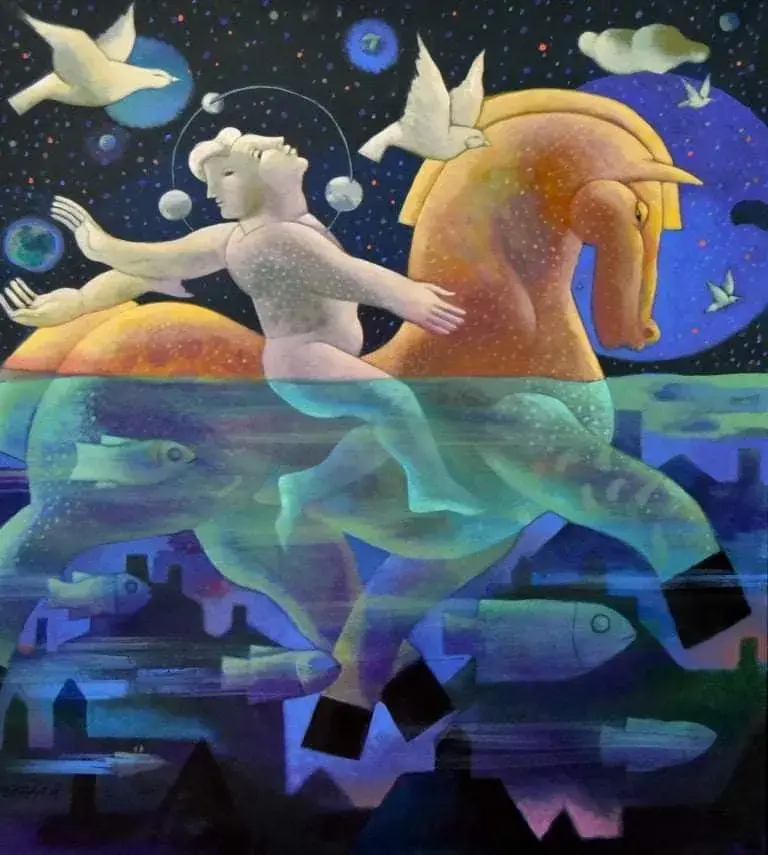
Your art is infused with a sense of human and spiritual liberation and your use of motifs such as horses, white doves, and bicycles, inspires intriguing questions about physical and spiritual boundaries. Is there intentional symbolism within these images?
Nazir: One grows up in an environment surrounded by certain images. So, for example, if you're born among Christians, there are a lot of crosses and a lot of icons. If you're born by the sea, there are a lot of fish and a lot of birds picking at fish. These images are symbols used in one's environment. The bird in the sky is not the same as the bird painted on the wall on the side of a building, a mosque, a church or whatever.
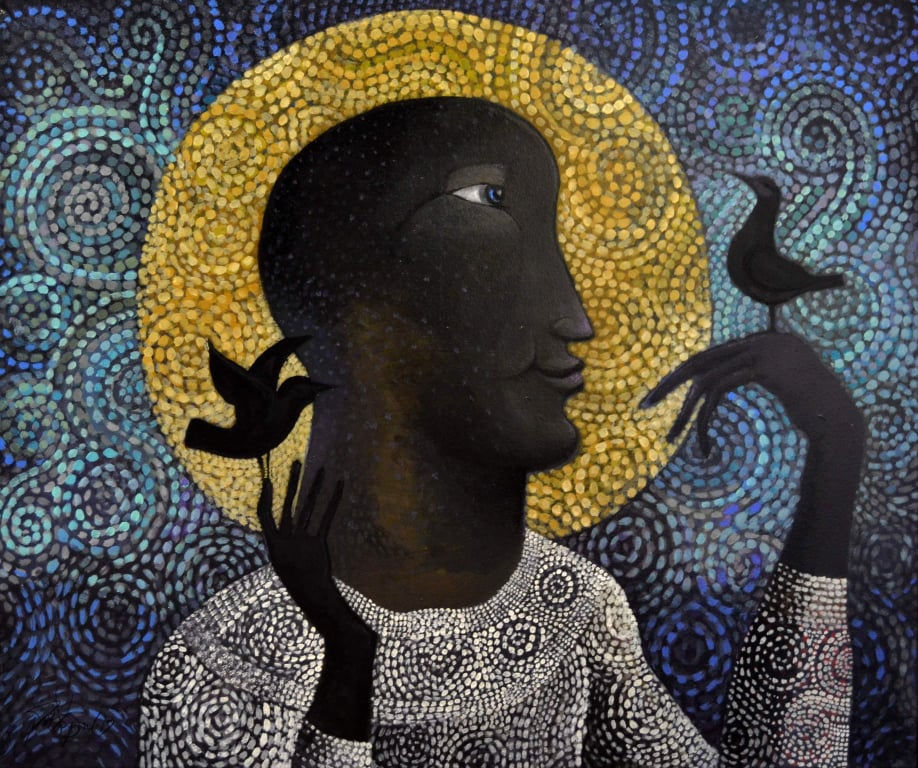
When you grow up with the spiritual meaning of some of these symbols, like the bird, the dove - Is it purity? Is it the soul? Is it the Holy Spirit? Is it the spirit of the dead coming to visit the body in the Egyptian Book of the Dead? You get curious, after it's already embedded in your psyche from growing up, and you start to learn about it. These symbols become part of your psychological language.
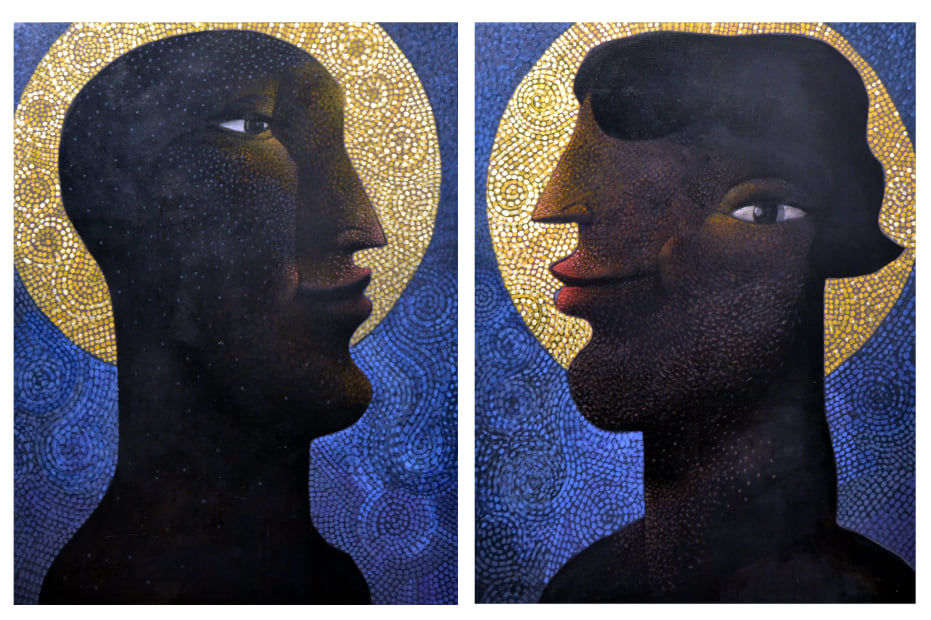
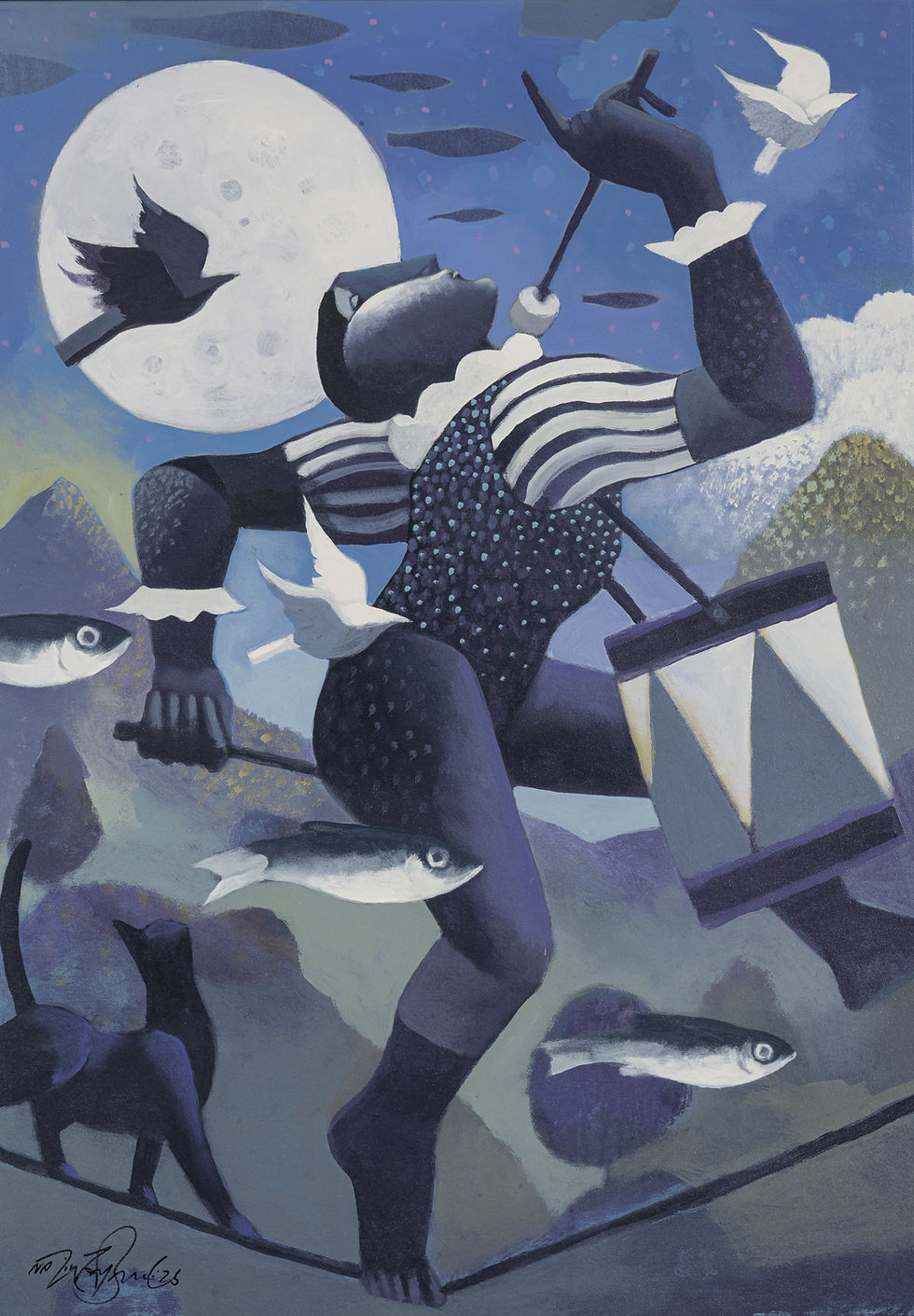
Nazir Tanbouli, Busker 3 (L) and Busker 2 (R), Acrylic on canvas, 100 x 70 cm
The bicycle is interesting. The bicycle is associated with the term “surrealism,” used by the early 20th century French poet Guillaume Apollinaire in his play The Breasts of Tiresias [which mixed opera with low-brow cabaret and absurd, dream-like scenarios]. He said that when man decided to replace his legs with a bicycle, that was a surrealistic act because the bicycle here is about men trying to transcend his physical energy into something else. So, for me, the bicycle is about a human trying to transcend and grow above his limited capacity and ability.
The birds for the Egyptians, like for the Sufis, represent the soul. When you follow the bird, when you follow your bird, you're following your soul guiding you along your journey.
The horse is the vehicle of heroes, but at the same time the hobby horse is the vehicle of a juvenile thinking that he is a hero.
In addition to your large-scale painting and drawing experience over the years, you have also done some “performance art.” What drew you to doing this?
Nazir: First, I draw every single day. When you work in figurative art, you need subject matter. And I wanted to give myself a reason to draw every day in the absence of subject matter. So, I reduced the whole thing to “mark making.”
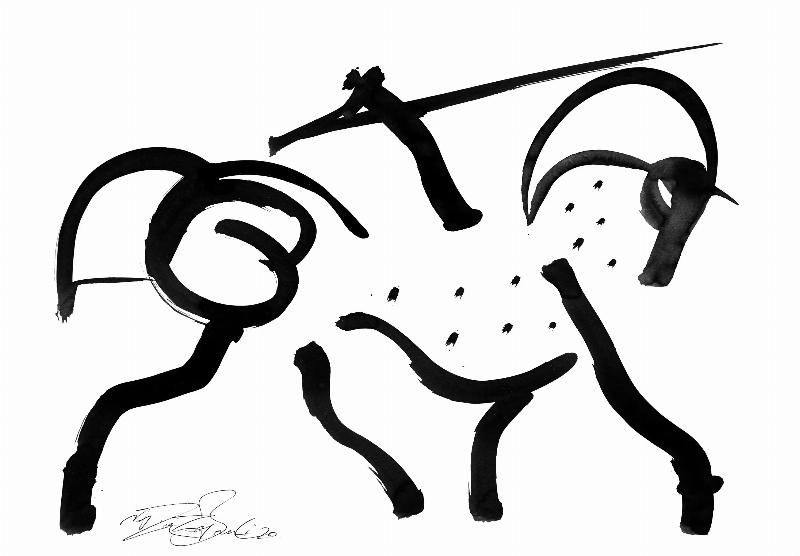
At the time, I was interested in mark making and meditation; the mark making and how it helps you move into a transient state. I also studied some Arabic calligraphy in art school and I love Japanese calligraphy. And I felt like I was standing between Arabic calligraphy, in which words have meanings I understood, and Japanese calligraphy which was an abstract art form for me.
I wondered how I could see Arabic language through the eyes of someone who doesn't read it.
If you’re sitting down while Japanese “chi writing,” it's about the synchronization of every single muscle in your body to achieve this line balance. I decided to try applying the rules of Aikido [Japanese martial art], which I was learning, to Arabic calligraphy.
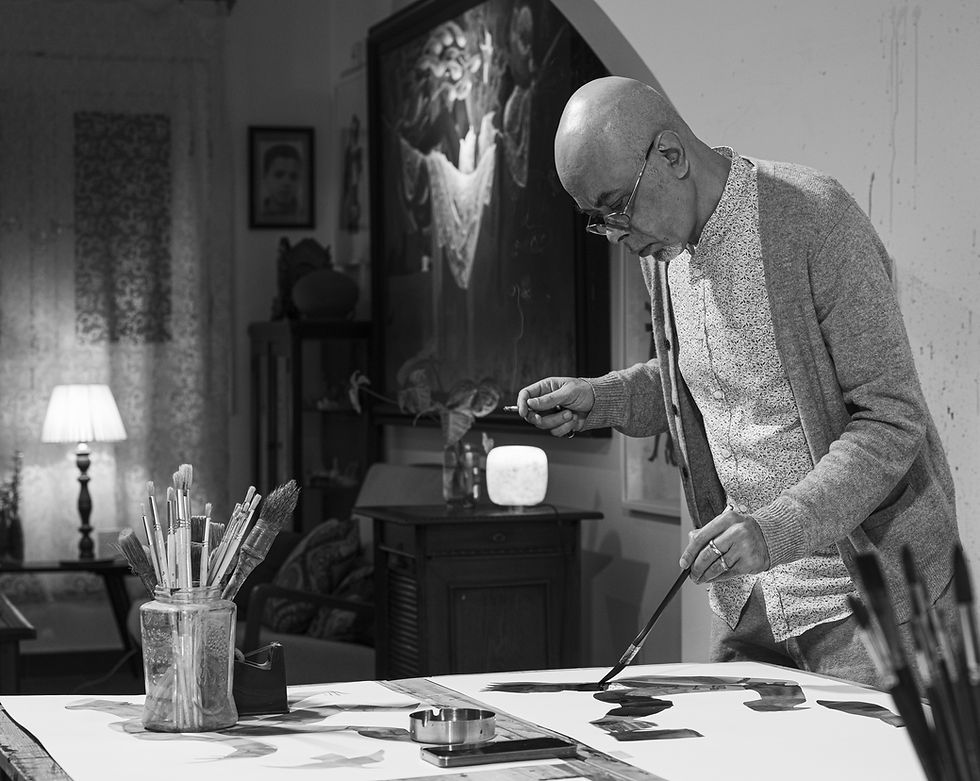
I started using paper, rolls and rolls of paper to exercise, and it started to become a kind of relaxation meditation. I used to do it for half an hour before I started painting my other work. Visiting friends would watch me draw and didn’t want me to stop. Then someone asked me to perform my drawing at a party, which eventually led to performing at the British Museum. It's very good for you because it really unpacks you and puts you together.
Painting allows you to find what's within you, because painting is like music. It's used to express the unspoken. The concept, the idea, is just a starting point, the beginning of the journey of the painting. Then paintings take you and you don't know where you're going to end. I feel like I allow the painting to manifest itself through my hands. I feel like I'm channeling something, what I love, processing it. It goes through my eyes to my brain and then it works in a crazy way and it comes back on the surface.
What do you draw inspiration from as an artist?
Nazir: Poetry. One of the good things about my dad is that he had a library room with walls covered in books. On the right side were books about the human subject, and on the left side was science and math. There wasn't much allowed in my house when I was young, but I was allowed to read whatever I fancied reading. My parents did not have much of money, so I did not go to an English school. But I taught myself English when I was a teen, starting with pop music, translating lyrics of songs and things like that. This was in the early 80s. And then I found this book of the complete collection of Khalil Gibran in my dad's library. It was very old edition. It had two pages facing one another, one written in English and one written in Arabic. To be honest with you, both pages were in sophisticated language. Even the Arabic was difficult for a 12-year-old. But what a way to start learning English, which from the beginning made me adopt a bit of old English from Gibran, words like betwixt.
When I found Gibran’s work The Prophet, I thought, I really like what this guy's saying and I'm getting something from it. So let me read it again. That was the first book that I felt like I wanted to read again and again and again and again and again. It also attracted me to his drawings. The book had some of his drawings, so I recognized that he was a painter as well. I was so, so excited. And since Gibran, there have always been poems coming and going in my head.
You sleep by day and you paint by night. Could you share with us a little about your process of creating?
Nazir: I live in a building in Cairo, with the first floor as a studio and the 3rd floor as a home. And I spend most of my time just working, like a monk really. I have three or four hours a day where I go upstairs, see to all the needs of my wife and my home, and we have a good long chat one-on-one. And I walk the dogs three times a day. Otherwise, I'm in my studio.
When I was growing up, we didn't have enough schools at the time so my school had to run different shifts - a morning shift, an afternoon shift, and a night shift - and then at midterm they would flip the schedule. And I never liked the schedule to change because I liked going to school in the afternoon. That was great for me. I like to sleep when I can see the sun shining. I don't like sleeping in the dark. And I like to be present at sunrise. It makes me sleep happily. And my brain activity really crystallizes after midnight.
I go to sleep around five in the morning, and I wake up at one in the afternoon. Then I take two hours to get myself ready for the day, sitting silently, drinking coffee. And then I take the dogs out and then I start to do activities like taking care of the plants, ordering shopping and stuff like that. But I do it from the studio. And I listen to a lot of audio books while I'm painting. I can combine reading and working at the same time. But there's something in my hand that keeps going while I'm thinking. And this is when the magic really happens, when I forget that I'm painting.
When I stand there and want to paint, I feel like I’ve lost every talent I have. I could be stuck for days just standing there, with no work getting done. Yet I want to work. So, it's about listening to something, having a conversation, having a laugh, and then suddenly I start working. I just have to be sitting in the studio waiting for this moment. As an artist once said, an inspiration comes, but it comes to the studio. You have to be there waiting for it when it arrives.

How do you feel your artistic process connects you to something deeper within or beyond yourself?
Nazir: What I paint now, and ever since I started drawing as a child, is about how I live. It’s like a diary I draw every day. It's more like a prayer. When I really started to draw every day, I found spiritual connection in my painting, in my drawing. All the healing, all the comfort, all the communication was something bigger. All the soul searching, all the thinking, all the regret.
I remember a conversation Henri Matisse had after a surgery when he felt grateful to the nuns who had helped him. He was a rich artist by that time. One of the nuns complained that their small chapel needed repair, so he volunteered to build and design a chapel for them. Even though they didn't like it at first because they wanted the classic style.
But nonetheless, Picasso had an argument with him over the issue. He said, as a Modernist artist, we do not pray. We do not believe in God. We do not pray.
And Matisse said, “No, we might not believe in God, but we pray. When we paint, we pray.”
I am like that. What is prayer, actually? It's a big question. I don't sketch for my work, I don't prepare for my work, I just start working and I build as it goes. So, the more I evolve, the more my work evolves.
You know, forever the biggest question for me is “what is God?” It's the definition of everything.
What has changed in your life over the years? How has your life and your work evolved?
Nazir: In middle age, you have what they call a midlife crisis. It's not midlife crisis, it's “midlife questioning.” I understand that life is very fragile, very temporary, and cannot be taken for granted. So, I try to celebrate and enjoy and suck the honey out of every single minute of it before it changes. That sense of gratitude created a new attitude in my work. I feel that an artist is like a doctor or a priest. I have to respond to the needs of society around me. Maybe when they are asleep, they need awakening, but when they are hysterical, they might need a hug, or a calming song. That awareness moved me from the radical to the beautiful because I felt like this is the medicine to share.
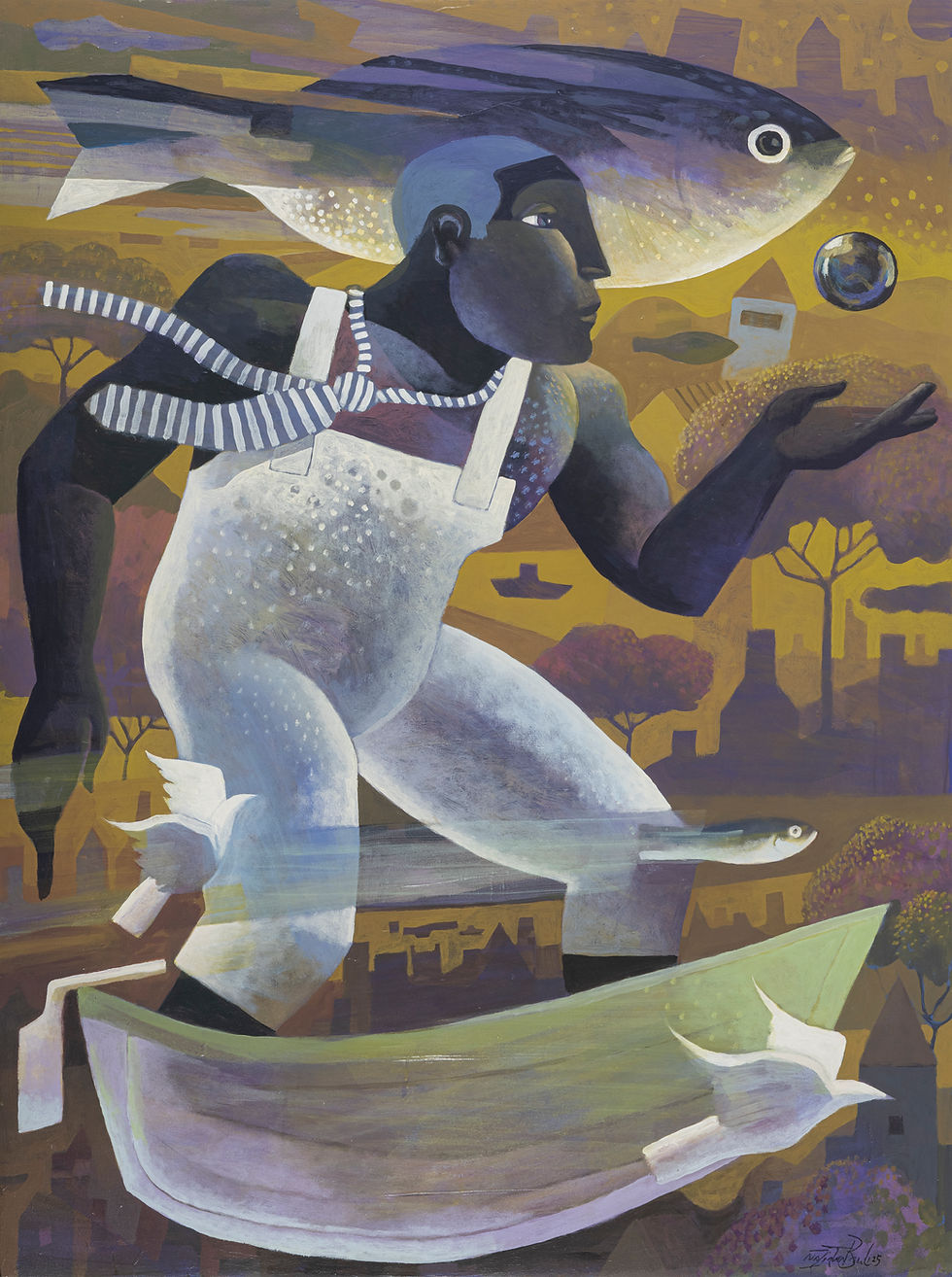
Could you tell us about your current exhibition titled "Bird on Wire," at the Yassin Art Gallery in Cairo?
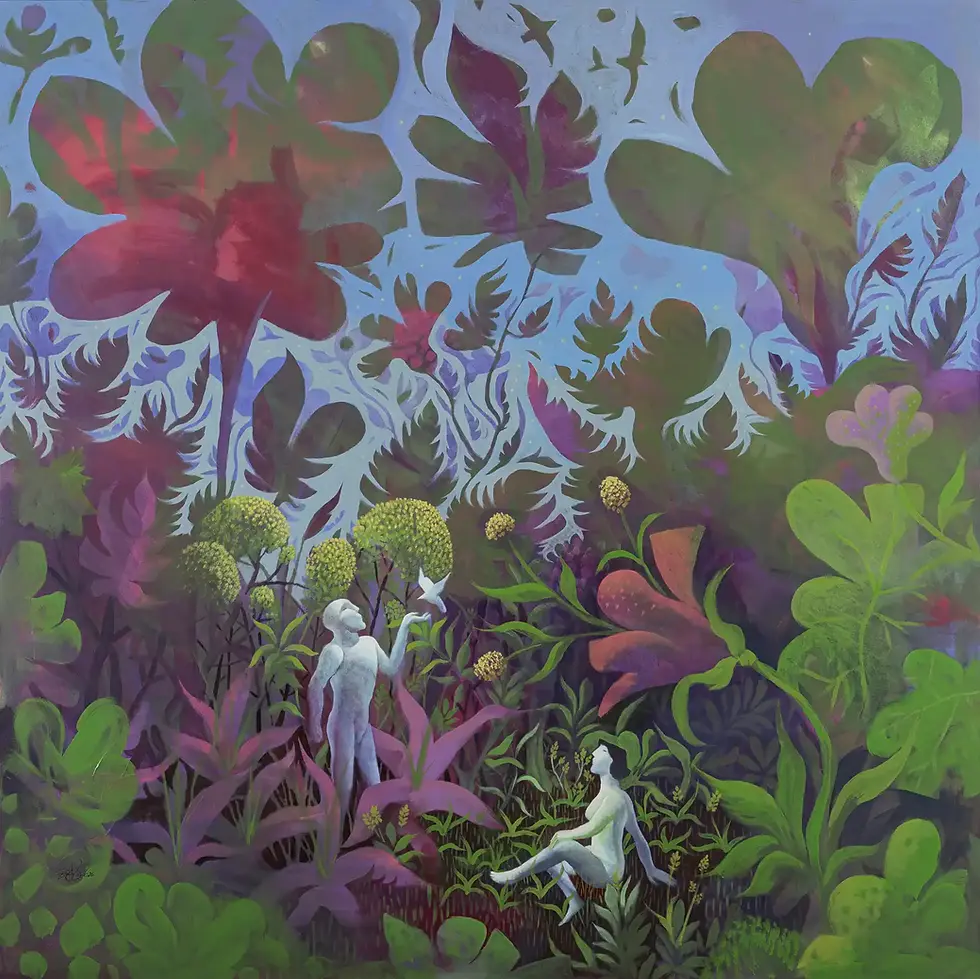
Nazir: My most recent exhibition, titled “Bird on Wire” [at the Yassin Art Gallery] is inspired by the title of a Leonard Cohen poem and song, really describes what I've done in my career so far.
Like a bird on a wire, like a drunk in a midnight choir.
I have tried in my way to be free.
And hallelujah, it worked.
“Bird on Wire” is an exhibition of 26 paintings.
At first, I didn't see how the show was going to become a coherent collection rather than just separate pieces. But putting the show up was part of the work. While I installed my art, I asked the gallery owner to stay at home, not to come to his gallery, and to take the day off. And I went there and sat for a few hours wondering how I was going to make something cohesive out of this group of paintings.
One thing I have done in my art is to combine three things I've learned from the church: beauty, power, and meaning. Ever since I was an art student, whenever I visit an exhibition or a museum, I do not go and look at every painting. I just walk fast. I make a point of walking fast until a painting tells me to stop in my tracks. I always want to imagine how I could make this charismatic painting and why it stops me.
When I go to an exhibition, I go to challenge art, to tell art it doesn’t exist, that I don't care. Stop me if you can; until a painting stops me. Then this is when I stop and learn.
One can combine beauty with a message within a charismatic framework to deliver both. Over time I have learned that rather than just trying to deliver a message to others, if I can be authentic to myself, I am more likely to arrive at authentic conclusions that touch others.


Lovely interview—Nazir Tanbouli’s view of the artist as someone who responds to society’s needs, like a doctor or priest, really resonates. Thanks for sharing his story and perspective.
Me parece útil encontrar información relacionada con los números de la suerte cuando se quiere conocer diferentes combinaciones numéricas. Este tipo de contenido resulta interesante para las personas que disfrutan de la numerología, ya que permite explorar significados, patrones y referencias que pueden servir como entretenimiento cotidiano.
kèo nhà cái 55 mình thấy mọi người nhắc hoài nên cũng tò mò bấm vào xem thử giao diện thế nào. Mình không có ngồi soi nội dung hay chơi gì cả, chủ yếu lướt qua xem họ sắp xếp trang ra sao cho dễ nhìn. Cảm giác đầu tiên là bố cục khá thoáng, các mục được gom theo nhóm rõ ràng nên kéo xuống không bị “ngợp”. Mình thích kiểu họ trình bày thông tin theo dạng khối và bảng cột gọn gàng, nhìn cái là nắm được ý chính chứ không phải đọc cả đống chữ. Thanh menu cũng đặt chỗ dễ thấy nên chuyển qua lại vài mục khá nhanh, không phải mò lâu. Nói…
This was a truly inspiring interview — I loved Nazir’s perspective on the artist’s role as a healer, responding to society’s needs. It adds so much depth to his beautiful work.
Bài viết rất dễ theo dõi, cảm ơn bạn đã chia sẻ. Mình cũng hay để ý cách các nền tảng giải trí trực tuyến chia mục và trình bày thông tin để học hỏi, chứ không đi sâu từng trò. Để tiện tra cứu, mình tự tổng hợp lại vài điểm và lưu vào một trang riêng để xem nhanh khi cần. Ai quan tâm có thể ghé. Ai quan tâm có thể ghé https://www.atozed.com/forums/user-95195.html