


Artist Spotlight - "Engaging Art to Change our World"

Updated: Mar 26
An interview with noted Egyptian multidisciplinary artist Heba Helmi.
Paul Chandler, CARAVAN's president, had the privilege of having an extensive interview with Heba Helmi, the remarkable Egyptian multidisciplinary artist based in the neighborhood of Maadi in southern Cairo, where he lived for ten years, and where CARAVAN originated.

“In my view, an artist is first and foremost a person seeking freedom."
- Heba Helmi, visual artist, ceramicist, and writer

Heba Helmi is an Egyptian graphic designer, painter, ceramic artist, and writer. She holds degrees in fine arts and art history and is the author of Gowayya Shaheed, published in 2013, a book documenting the street art of the Egyptian Revolution. Heba Helmi lives between Cairo and the village of Tunis-Fayoum (the center of pottery production in Egypt), as she extended her creative production to ceramics. Inspired by the Islamic tradition, she experiments with new materials and techniques looking for novel ways to fashion clay. She brings her expertise and love for Arabic calligraphy to her ceramic creations inserting hidden messages or slogans that caught her attention during the 2011 Egyptian Revolution in some of her works. Heba also works as a graphic designer for several publishing houses and has a studio and gallery in Fustat, the center of ancient and contemporary pottery production in Cairo, where she paints and creates pottery. She holds regular exhibitions in Egypt.
For more information:
-Instagram:@hebahelmi
-Works for sale: https://artiatique.com/collections/heba-helmi
NOTE: In all of CARAVAN's artist spotlights, the opinions and views expressed are those of the artists.
______________________________
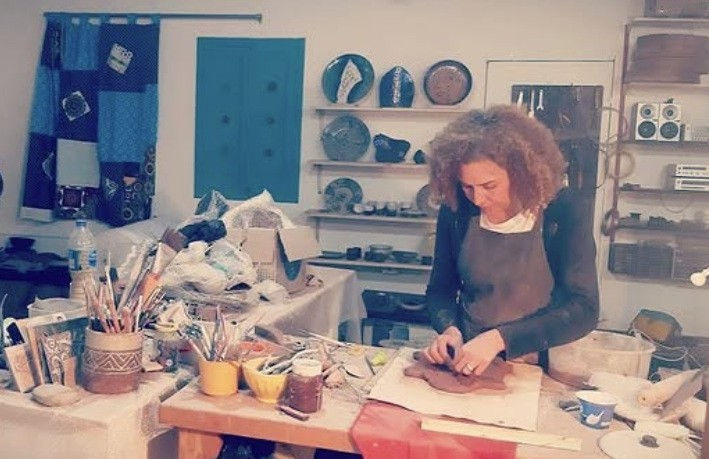
What first sparked your interest to create art, and what formative influences have shaped your life as an artist?
Heba: I don’t remember exactly what made me love drawing since I was a child, but I can perfectly recall how enjoyable and special that time was. It was a time when I would lose myself in shapes, colors, imagination, and my own soul. My dear uncle also encouraged me greatly and appreciated what I created, so drawing became a core part of our bond. We would draw together, and I could see the image of his admiration for me in his eyes.
While preparing for this interview, I had to go through all the art work I have created over the years to choose what to share with you that would best represent me as an artist within the allocated time. To tell you the truth, it was not an easy exercise but quite enjoyable process that allowed me to go through my whole journey as an artist with the many turns that it took and lead me to where I am right now. I will try to take you through these different stages I went through and the art I created through the years and the events, places and people who inspired me and influenced my work.
I will start from my formal education and training at the old prestigious School of Fine Arts in Egypt where we learned all about the classical rules of European art and the Western academy with very little about the glorious Egyptian esthetics of its art and crafts.
As a young student, I wondered, why don't we study how to write or draw hieroglyphics? Why isn't there a course on "Arabic calligraphy"? Why haven't the artistic solutions and rules invented by Eastern art been adopted in the fine arts curriculum? Thousands of years of Egyptian civilization and art were piled up in museums, temples, churches, mosques, libraries, and tombs in every city in Egypt around us. All of these resources were certainly inspiring, but they remained the background for us art students who looked to the West.
The urge to learn more about the layers of Egyptian art pushed me to search for mentors and to visit places famous for certain crafts. I learned a lot through this search and reinvented myself through experimenting and learning by doing.
After all, isn't art an experiential learning process?
After the 2011 Revolution in Egypt, you decided to produce a book documenting the graffiti of the revolution. How has your view of art's role as a historical record evolved now that many of those physical walls have been erased?
Heba: The Egyptian Revolution in 2011 changed everything. It even marked time to “before” and “after” the revolution. As for me I no longer see the world in the same way. The revolution opened the doors and gave us “Egyptians” great hopes and we went through great disappointments. We got to know each other, we talked, we participated, we dreamt and many were killed in the streets.
From the womb of this revolution the graffiti was born and swept through the streets of Egypt. It kept pace with every event, announcing the political position of the revolutionaries, comforting the families of those who paid with their lives, mocking the confusion of the rulers, and resisting the counter-revolution. At that time, I felt that I had to document this.
Graffiti was the ultimate art of the people who created it, chose its location, and took over public space to express their struggle. They took art out of the galleries and made it available to everyone. I saw walls telling the story of the revolution’s daily life. These walls would shine, be attacked, fade, and then smile again. They were also a space for messages between protesters. For example, the Ultras used coded signs to mark safe paths for marches. Revolutionary groups used stencils during the Friday marches, leaving messages in every neighborhood they passed through. They left a trace of the revolution behind them.

Through this art, we know exactly where a battle started and where it ended. On Mohamed Mahmoud Street, the walls of the American University were covered in murals of the faces of people who had been killed. These paintings were full of color and great artistic skill. But as we walked toward the Ministry of Interior, these detailed murals began to disappear. They were replaced by quick stencils or short sentences sprayed in a hurry during clashes with the police. Protesters wrote them while breathing in tear gas. When the graffiti stopped completely, we knew we had reached the gates of the Ministry.
I sought through my book titled Gowayya Shaheed to chronologically document the events of the revolution and introduce this Egyptian street art. My book situates the graffiti in its wider political, spatial and historical context, and comes along with my own testimony as an artist and as an activist in the revolution.

In 2022 you participated in an exhibition organized by the French Institute of Egypt commemorating the 200th anniversary of the deciphering of the ancient Egyptian hieroglyphs on the Rosetta Stone. Your work uniquely blended ancient hieroglyphics, Coptic woven art, Arabic calligraphy and your own created letters. In what ways did this experience bring together your varied giftings and interests?
Heba: I made use of the French Institute for Oriental Archaeology (IFAO) printing press which was established 150 years ago in Cairo to create these paintings and ceramic pieces. For a long time, this printing press was the only one specialized in producing books and materials in hieroglyphic language in the region as well as the most important books on Egyptology of its time. Being inside this historical building amidst the machines, tools and printing letters made of hieroglyphic, Arabic, and Latin letters I was deeply touched and inspired.

Hieroglyphics are sacred writings, and the writer is referred to as the guardian of the sacred or “the one who handles the secret of knowledge and hidden sciences." In the journey I took through time in search of this mystery, I created contemporary steles and tablets from clay, the oldest raw materials used to record human history, which I sealed with the letters of the printing press invented by other human beings who lived hundreds and thousands of years later.
The layers of Egypt’s history accumulate on top of one another and shape contemporary Egyptian identity. Archaeologists work to decipher them. As for me, I go in the opposite direction. I intensify the obscurity by mixing the hieroglyphic language with Arabic calligraphy and the arts of Coptic weaving to create a new multifaceted language and become the gatekeeper of the hidden sciences.

In my exhibitions titled 'Talisman' (2019) and 'My Name is Blue' (2020), I mixed art materials and media of significant variation. My work spanned from Arabic calligraphy, inks, and printing technologies to ceramics; and from leather, sackcloth, and silk to patchwork and sewing. All utilized to create contemporary charms and amulets and fossils for the future that might one day find someone to decipher.

You have spoken of your calligraphy work as meditative, and the classic curves of the letters of the Arabic alphabet as inspiration for developing your own alphabet. Can you tell us about this aspect of your artistic journey?

Heba: In the field of book production and cover design I worked for various cultural publishing houses for over 25 years.
Through my work I was intrigued by calligraphy, so I decided to learn from the Sheikh (master) of calligraphers, Mohamed Hamam, who designed the title for a novel cover I was working on.
This experience opened my eyes to the aesthetics of eastern traditions and treasures of heritage: manuscripts, paintings, copied decorated books, gilding and ceramic.
For me, it was an inspiring source of beauty and a magic gate that I had to cross to reach the depths of its secrets.
Letters are composed of a set of movements and directions. These movements are governed by pre-determined measurements, proportions, and laws. These laws are what give each script its own character and its own special artistic and aesthetic imprint.
However, I did not adhere to these rigid rules. I maintained my freedom to compose and create my own letters, my own alphabet. And with those composed letters I created a new writing with an old essence, inspired by Arabic, Coptic, and Hieroglyphic.
In your 2023 exhibition Baqaa’ (Everlasting) you invite visitors to participate in writing the names of children who died in Gaza on a 28-meter shroud that you eventually sculpted into a woman wearing a bridal gown titled “The Bride.” How did this communal act change the meaning of the work compared to if you had inscribed all the names yourself?
Heba: I was preparing to exhibit my work according to a pre-established schedule in November 2023—when massive events happened in a place close to home and dear to my heart and soul. In the blink of an eye, the horrific war in Gaza erupted. Suddenly people were stuck in front of their mobiles and TV screens watching the news and witnessing on air images of the mass killing of Palestinians in Gaza as victims were reduced to numbers, and passing minutes became a counter of death. The sunset became the gate to the kingdom of darkness, an underworld of innocent people buried under the rubble of their own homes, and the sunrise revealed the real ugliness and cruelty of the face of this planet.
The war in Gaza had been going on for 32 days. Suddenly, I found myself in a dilemma… What shall I do? Shall I continue with my initial plan for this exhibition as if nothing is happening? And how? I am living this crisis with my whole being and soul, and my heart is aching. I was swamped with feelings of anger, sadness, and frustration and I needed to find a channel to express them rather than swallowing the bitterness and rage.
Then I decided to go with my feelings and a new exhibition came into being… and I call it “Bakaá” (Everlasting) which means eternal and constantly recurring to describe the just cause, the resistance, the survival and existence of the headstrong Palestinians, and most importantly keeping the murdered children alive through inscribing their names to defy the failing of our memory. The artwork Bakaa exhibition is a collective project carried out by children, young people and adults who participate wholeheartedly with me in writing down the names of the children killed in Gaza on shroud fabric. I obtained the list of the those whose lives were cut short from the Palestinian Ministry of Health, which consisted of 2900 names (up until that time). I invited visitors to join in inscribing the names of those victims of this epic for safekeeping from obliviousness, for they are a compass to save our own humanity.

In Arabic, we write our names as this: first name, father's name, grandfather's name, and family name. This allows the reader to identify the family ties between these children. We can discern whether they were brothers, cousins, or had a common ancestor. Nothing was more difficult than recording the names of these children on the shroud cloth, visualizing the building where their extended family lived, and the street that embraced their play.

In my home, which I opened to participants, a long shroud of fabric lay across the dining table, surrounded by pens and papers printed with the names of the victims. At first, only friends joined in the writing, but soon, strangers started coming too. They were people from all backgrounds—men, women, and even children. The only thing they had in common was a need to do something, anything, to face the helplessness they felt while watching the news. It was an opportunity for all of us to talk, to connect, and to grieve together.

This connection continued during my exhibition at 'Al-Bab' Gallery in Cairo. Visitors would come, and we would cry together, embrace, and talk. I remember two women who came every day. They wrote the names in total silence and with such devotion, as if they were performing a sacred prayer. Those days gave me new friends and a reason to believe in people again. They gave me the comfort and the hope I needed to keep going.

In my collective exhibition titled Trio in October 2025, after two years of horrific destruction and the systematic killing of all forms of life, Hiroshima appeared small and dwarf-like to me, and hell and its imagined horrors seemed to become real on the soil of Gaza. It led me to tear up the shrouds, the 28-meter-long piece of burial shroud fabric inscribed with the names of the children, and build the names anew; so, I weaved them into various kilims and sewed them into a wedding dress to keep them whole in memory until they are resurrected. May their names live on.

Below: Watch a moving short video clip of Heba Helmi's "The Bride" installation, commemorating the thousands of innocent children that died in Gaza:
The way in which you have joined your passion for pottery and calligraphy has resulted in very innovative work. What inspired this creative development?
Heba: While I was studying Arabic calligraphy and the art of manuscript illumination, my passion for ceramics began to grow in Tunis Village, Fayoum. Since I have a home there and my background is in painting and design, transitioning into clay felt like a natural step—especially being surrounded by the potters of Tunis and learning from masters like Evelyne Porret and Michel Pastore.
I started by painting on plates and cups across five different workshops. To deepen my craft, I studied online lectures and revisited my school-day love for chemistry to understand the glazes. I constantly questioned Evelyne and Michel and read extensively about ancient techniques. This journey led me to discover my artistic ancestors from Fustat in Egypt, Samarra in Iraq, and Málaga in Spain, whose work I had admired in Cairo’s museums.
I decorated my pieces with my new language, inspired by how early Islamic potters blended script, verses, and art. What truly drew me to ceramics was the endless room for experimentation—and that is exactly what I began to do.
The ancestors who crafted this heritage in Fustat—the very same neighborhood where my Cairo studio stands today—have always been a profound source of inspiration. I can feel their energy and their spirits around me. I often imagine one of them, in this exact spot where I now open my kiln, contemplating a ceramic plate with a 'beautiful mistake'—one that sparks a new idea in his mind, just as it does in mine.
"Having studied this heritage and mastered the craft, ceramic has become for me a vast field for experimentation - a space where drawing, painting, color, and sculpture all converge as one."
- Heba Helmi

You have noted that working with ceramics in the desert oasis village of Tunis-Fayoum always brings surprises because "no one can guarantee the effect of the oven." How do you balance your artistic intent with the unpredictable nature of the firing process?
Heba: Kilns vary in their design and fuel sources, but for a potter, the true distinction lies between flame-based kilns—powered by oil or gas—and the uniform, flameless heat of an electric kiln. Within a flame kiln, the fire moves restlessly, creating uneven temperatures; the direct touch of the flames on the clay produces effects that often defy the artist’s own expectations.
The second crucial factor is the firing technique itself. When I use 'reduction burn’ to achieve 'Metallic Lustre' (a technique pioneered by Muslim artists in Iraq), I am essentially introducing a heavy amount of smoke/carbon into the kiln at a specific time and temperature. This smoke moves randomly and freely inside, reacting with the metal oxides in the glaze. These chemical reactions birth new metallic hues—ranging from golden yellows and deep crimson reds to midnight blues, depending on the chemistry of the glaze and the movement of the smoke surrounding the piece.
I call this the 'kiln’s genie' or the 'artistic sprite.' Every potter knows it well; we wait for its surprises, which can bring either pure elation or deep frustration. The more a potter masters the craft, the more they control the outcome—yet there always remains that margin of surprise. The moment of opening the kiln remains, forever, a moment of profound passion.

You often intentionally arrange your work, particularly your ceramics and layered ink pieces, to guide visitors on what you call a “spiritual and mystical journey.” Are there ways in which your spiritual faith has influenced your art? And in what ways does your art seek to be a bridge between the unseen, spiritual world and the tangible, material world for the viewer?
Heba: In our history, a calligrapher was more than just a skilled worker; he was the guardian of a spiritual message. Traditionally, a calligrapher was only recognized after receiving the 'Ijaza' (certification) from a master—a sacred bond passed down through generations.
"For a calligrapher, the process is spiritual by definition. It starts with preparing ink mixed with perfume and burning incense to fill the room with peace before beginning to write. This spiritual dimension makes calligraphy a form of meditation."
-Heba Helmi

Today, in my studio in Fustat, I feel I am bringing this heritage back to life. Mastering the craft of ceramics and practicing calligraphic exercises (Mashq) on paper and clay is not just decoration for me. It is my own 'Ijaza,' granted to me by this land and the spirits of my ancestors. In my hands, these letters have transformed from ancient texts into a coded language. They carry our identity and document our modern life with the same sacredness found in ancient manuscripts. At least, this is what I aim to do.
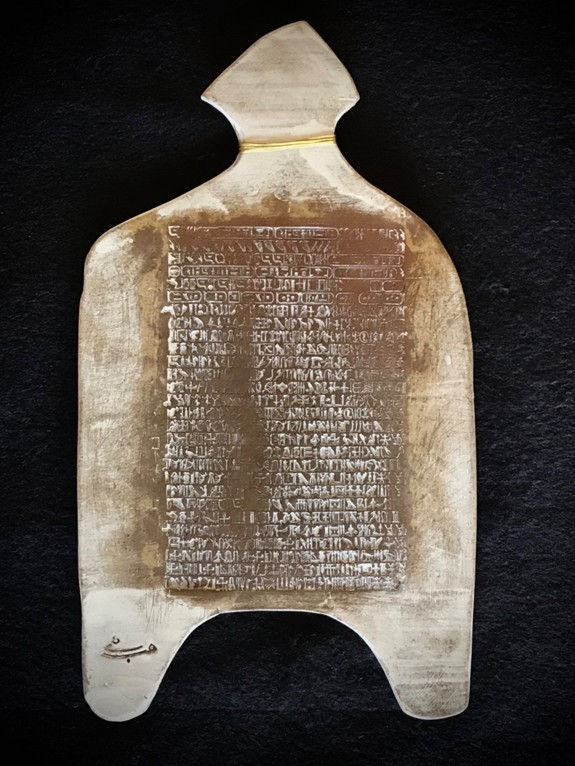
"The below ceramic piece is shaped like the traditional wooden board used in Islamic schools (Kuttabs). I chose this shape because it is already a historical tool of knowledge and a spiritual space. For me, this form perfectly reflects my artistic work on human and spiritual knowledge."
- Heba Helmi
You spend part of your time working amid village life in the desert oasis of Tunis-Fayoum and the bustling metropolis of Cairo, as well as in France. In what ways do these different cultural landscapes influence your creative work?
Heba: There are distinct differences between the places I’ve worked, but also many similarities. These differences appear in the tools, the materials, the types of kilns, and even the clay itself.
In Tunis-Fayoum Village, potters get their raw materials from Cairo, but they work surrounded by nature—green trees, birds, and the view of Lake Qarun with the desert behind it. This close relationship with nature directly affects their work; you see motifs of palm trees, buffaloes, and migrating birds. Their pottery feels rustic and raw. However, it sometimes bothers me that many workshops repeat the same colors and patterns without much artistic risk, though this doesn't take away from the beauty of their craft, which remains mostly a family business.

In Cairo, potters work in the city—no fields, no birds. The workshops are larger, with a traditional hierarchy of a boss and workers. Unlike Tunis Village, where women are master potters and business owners, you rarely find women working in Cairo’s traditional workshops.
What surprised me most in Cairo was the obsession with perfection and uniformity. Both traditional potters and 'ceramic artists' try to compete with factories, aiming for perfectly regular shapes. When I opened my studio in the neighborhood, I was amazed by this goal. I believe that the human touch—with all its imperfections—is lost when we try to mimic factory-made products.
In both Tunis and Cairo, you find clay splattered on the walls and creative chaos everywhere. Potters prepare their own clay in large basins inside the workshops. This is something I didn't see in France. The studios there, especially in the city, are so organized it’s almost suspicious—I’m joking, of course. In France, the clay comes pre-packaged and ready from the factory, and you buy the glazes ready-made. If you want a specific effect, you can just find it in the market. This is very different from Egypt. Not to mention the endless colors of clay and the high quality of glazes, which are as expensive as they are excellent.
I was very lucky to work in these three different environments, each with its own techniques, materials, and atmosphere. Dealing with these differences has deeply enriched my experience and gave me many ways to look at the world of ceramics. I have learned so much.

What advice would you give to young artists who want to address political crises through their art without losing the aesthetic or spiritual quality of their work?
Heba: I believe politics is simply the art of managing our world and our lives. It is not separate from culture, art, or literature; it is an essential part of how humans handle their affairs. Of course, the politicians themselves and their goals are a different matter.
In my view, an artist is first and foremost a person seeking freedom. By letting their imagination run wild, an artist can connect things that logic cannot, creating something entirely new. This ability to imagine a better world means, in my opinion, that the artist should play a role in change—though I know not every artist agrees with this.
I don’t mean that an artist should become a political activist who organizes people or recruits them to revolutionary ideas. Artistic work itself is a revolution against the familiar and against what is accepted as 'common taste.' An artist is always challenged to discover something new. In times of great crisis, like the ones we face today, I find it hard for any artist to ignore war, genocide, revolutions, or pandemics.

However, it is a difficult path. A creator might fall into the trap of being too direct or literal, which can take away from the depth of the art and its ability to express human dreams. I believe that suggestions and symbols are the way out. By using symbols or choosing materials with deep cultural and historical roots, an artist can create 'engaged' art. A subtle hint is often more powerful than a direct statement.
Ultimately, an artist has no choice but to resist power in all its forms: the power that limits the freedom necessary for creativity, and the power of self-censorship. The reality we live in is not an inescapable fate. Creativity is simply the imagination breaking away from the familiar to create something new and wondrous—and perhaps, to promise a more beautiful future.


NOTE: "Handala" is a prominent, barefoot, spiky-haired cartoon character created by artist Naji al-Ali as a symbol of the refugee and refusal of injustice. Handala appears barefoot, in simple clothes, with his hands behind his back, turning his back on a silent world.


GG88 có dễ dùng không nhỉ; mình thử lướt vài phút thì thấy cũng ổn, kiểu vào là nhìn ra ngay chỗ cần bấm chứ không phải mò mẫm; menu điều hướng đặt rõ ràng nên đổi mục nhanh, kéo xuống thì các khối nội dung chia tách gọn gàng nên mắt đỡ mệt; mình chỉ đọc phần giới thiệu thôi, thấy họ nhắc khá nhiều đến tiêu chuẩn vận hành chuyên nghiệp với bảo mật, nghe không hoa mỹ mà đủ để yên tâm khi xem thông tin; mấy đoạn nội dung cũng viết theo kiểu ngắn gọn, có tiêu đề rõ nên không phải đọc liền một mạch mới hiểu; nói chung mình thích cách họ chia bố…
The interview with Heba Helmi offers a fascinating glimpse into how personal history, culture, and experimentation can shape an artist’s work. I especially appreciated her reflections on Egyptian art, Arabic calligraphy, and the relationship between creativity and historical memory. I recently discovered https://360haz.com/, and its review-style content also explores interesting perspectives. This was an engaging and inspiring feature.
Reading this interview and diving into the creative journey and artistic vision of Egyptian artist Heba Helmi is truly wonderful! Art transcends linguistic and cultural boundaries, connecting people through beauty and sincerity, and that kind of creative power is always so moving. Sometimes after enjoying an inspiring art interview and letting my mind digest all those reflections, I like to hop onto minigame to play some quick, free, no-download casual games to clear my head and unwind. Thank you CARAVAN for such a brilliant artist feature!
Helmi's approach makes me think about how different it feels from the usual gallery show that stops at contemplation.
<a href="https://image2-5.org/
">image 2.5</a>
The interview frames art as a tool for change, which is compelling, though I wonder how that balance works when the work also has to stand on its own visually.
Reading about Heba Helmi’s multidisciplinary practice reminded me of local artists I’ve met who move between painting and installation.
<a href="https://nano-bananapro.com/
">nano banana pro</a>
They often say the medium changes how viewers sit with a difficult idea. I wonder if that flexibility is what makes socially engaged work feel less like a lecture and more like a conversation.