


Artist Spotlight - A Christian artist in a mosque becomes a 'Golden Ratio'

Updated: Jan 24
An Interview with the renowned Lebanese-Armenian muralist Harout Bastajian
CARAVAN's president, Paul G. Chandler, recently had the opportunity for an in-depth interview with the US-based Lebanese muralist of Armenian descent, who as a Christian is celebrated for decorating mosques around the world, and is often referred to as the "Michelangelo of Mosques."

“Art and nature showed me the handprints of a Creator"
- Harout Bastajian, artist

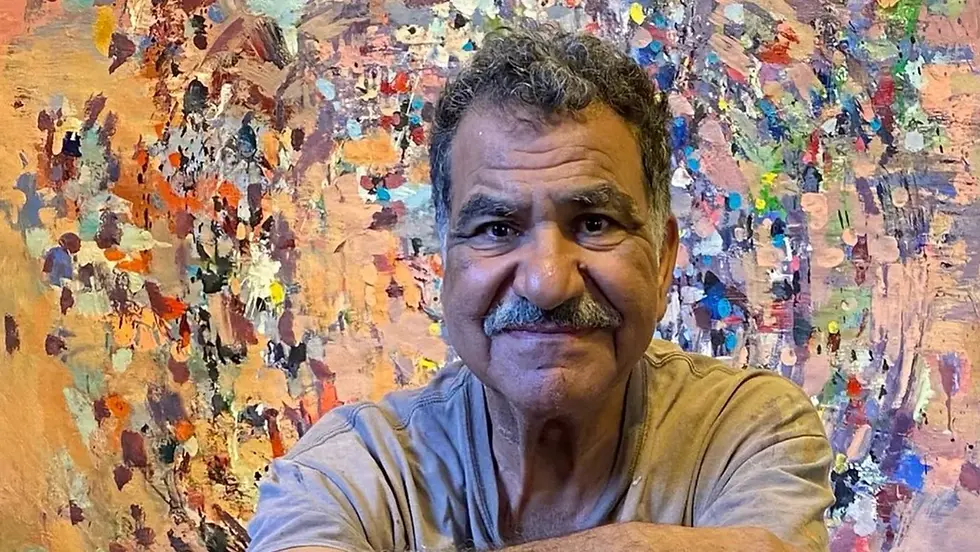
Harout Bastajian is a renowned US-based Lebanese muralist of Armenian descent, celebrated for his large-scale works that blend historical Arabesque patterns with traditional Islamic calligraphy, geometric designs and vegetal motifs. Drawing from both cultural and religious heritage and mathematical precision, his art reflects a deep sense of unity, order, and transcendent beauty.
His multifaith upbringing in Lebanon serves as a primary inspiration in his artistic work. What surprises many people, is that while a specialist in Islamic art and considered a master in mosque decoration, he is a Christian from the Armenian Apostolic Church (Orthodox) tradition. He is often referred to as the “Michelangelo of Mosques,” albeit a description he humbly eschews. Harout Bastajian has decorated 48 domed ceilings of landmark mosques around the world, across the Arab world, in West Africa, and in the United States.
The Arab American National Museum in Dearborn, Michigan recently held an exhibition titled “The Art of Spiritual Enlightenment” celebrating Harout Bastajian’s work on domes, offered visitors a close-up view of his large-scale designs through original panels and photographic displays.
For more information:
-Website: https://mosqueart.com
-Instagram:@mosqueart
-Video - watch an inspiring short video about Harout Bastajian's work at the Islamic Center of America - see: WXYZ-TV Detroit | Channel 7
NOTE: In this interview Harout Bastajian refers to the "golden ratio." For those not familiar with the term, it is a unique, aesthetically pleasing mathematical proportion.
______________________________

I would love to hear how you became an artist. Can you share how that came about, and who or what has most influenced you in your artistic journey?
Harout: It was in the early 1980s, I was almost ten years old when Lebanon was at war and we had to move to the safer countryside to escape bombardments. I’ve loved drawing ever since I was able to hold a pencil, and the countryside with no electricity and TV was the perfect place to discover nature in detail. I had all the time in the world to see the perfection in everything around me and copy it on paper; my best time of leisure was drawing and painting. At that time as a child, I used to get hints that there is more in everything around us than what we see. Later at college I was surprised to learn that one of the "hidden things" was the golden ratio.
While you were raised in the Armenian Apostolic Church (Orthodox) tradition in Lebanon, it was within an environment where church bells and calls to prayer from mosques echoed together. How is your current work a continuation of that childhood experience? How has your upbringing in Lebanon influence your work as an artist?
Harout: In the countryside where Muslims, Christians and other ethnic and religious groups lived in peace, I remember during hot summer days playing with my matchbox cars on the grids of the carpet of our mosque next door, and walking to the nearby church with my mom and siblings when the church bells rang. Years later, I felt the nostalgia of the mosque call to prayer mixing with the church bells. I have even experienced this in Dearborn, Michigan, where St. Sarkis Armenian Orthodox Church is located next to the Islamic Center of America. Now I go with my family to the Sunday mass and then pass by the Islamic Center of America for a Middle Eastern breakfast with friends and family.
I grew up in a diverse environment and I was brought up knowing that people are good and similar, regardless of their religious beliefs. I spent my childhood at the mosque and the church, watching good people praying to the same God in different ways. I was mesmerized with the large-scale art in those houses of worship and when I got the chance to create art in houses of worship, I did everything in my power to give my best, first of all to God, and then to the community that entrusted me with such work.

"I was brought up knowing that people are good and similar, regardless of their religious beliefs."
-Harout Bastajian
The revered artistic tradition of Islamic calligraphy turns Qur’anic text into art, bridging the sacred words of God within Islam with visual beauty and human devotion. In what ways does your own faith resonate with this spiritual and creative work?
Harout: Regarding the tradition of depicting Qur’anic verses with Arabic calligraphy, it is the result of centuries of artists and scholars putting lifelong resources into perfecting it. Arabic calligraphy is very complicated with all its details and diacritical notes. It is true that a lifetime is not enough to master it. I think that Qur’anic verses and Arabic calligraphy give a mosque its divine identity. When I have had non-Arab American artists help me in a project in a mosque, copying, gilding and contouring Arabic texts, they would say, "we don't know what we're drawing, but we love what we're doing."

As a Christian who has decorated nearly 50 mosques, you’ve said "God works in mysterious ways" to bring people together. How has your own faith evolved or deepened by spend months immersed in the calligraphy and motifs of Islam?
Harout: Since my childhood I have questioned everything around me, this included faith and the existence of God, even though my mother held my hand and dragged me to church every day. I still had many unanswered questions, and a bearded man in a black robe didn't have satisfying answers for me until art and nature showed me the handprints of a Creator. The golden ratio is everywhere around us, in every detail, even in the distant cosmos; this is the only thing that strengthened my faith and belief in God, and made me a true believer. How lucky I am to be commissioned to decorate God’s houses of worship, putting all my resources to work to do my best to decorate a space where thousands, maybe millions of believers, will visit and worship the Creator for centuries to come.
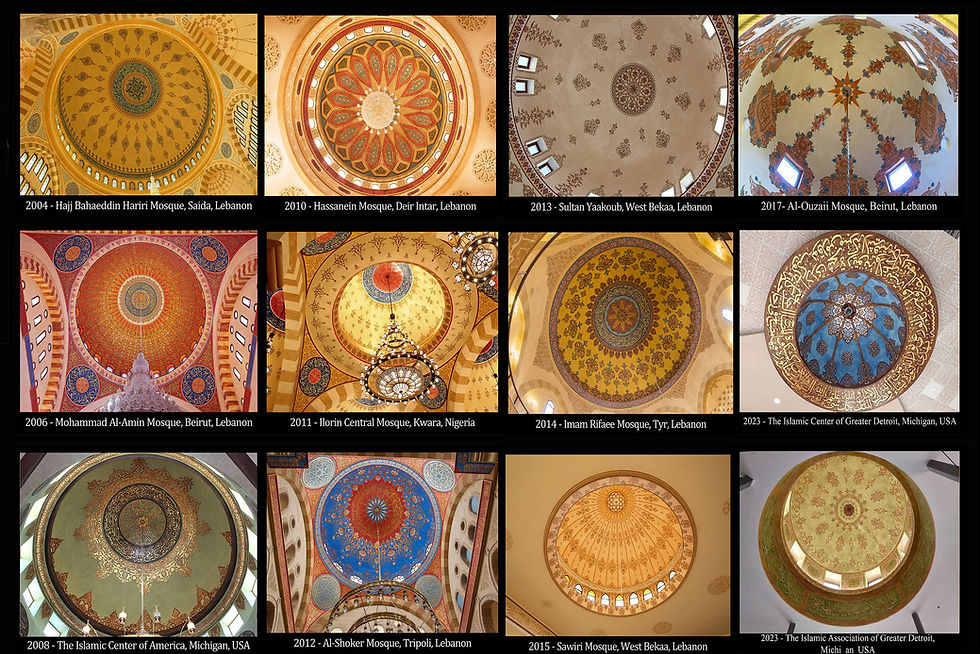
You have said that Ottoman (Turkish) designs often work better for Sunni mosques while Persian-influenced styles suit Shia spaces. Can you share an example that highlights the differences in natural motifs or scripts to ensure they respect these distinct religious identities?
Harout: When commissioned to decorate a mosque or a church, my first question is, "What is the religious sect and ethnicity of the worshippers?" My job is to use design elements that reflect their background, usually Sunni mosques use Ottoman floral and vegetal ornamentation, integrated with geometric Arabesque patterns, while Shia mosques use Persian, Safavid elements with integrated geometry.
Having in mind that art is always dynamic and always evolving, my job is to use the main historic decorative elements, transform them into similar but original motifs and integrate them in the space, while respecting design balance and the golden ratio. And this is one of the key elements of success in my career. There will be studies and criticism of the final product in the years ahead, but it won’t be successful if you simply copy and paste just what people like. It usually takes more time studying and preparing for a project than actually executing it.

"I think that Qur’anic verses and Arabic calligraphy give a mosque its divine identity."
-Harout Bastajian
You have mentioned that the circular shape of a dome has "something divine in it" because it has no beginning or end. How do you use the Golden Ratio* (1.618) to translate this spiritual concept into precise geometric patterns? How do you adjust these calculations to account for the way a viewer's vision shifts from 150 feet below?
Harout: I remember the first mosque dome I was commissioned to decorate. I was in my late 20s, and I was hardwired to say, "Sure, I can do it." The dome was 45 meters (147 feet high), and it covered around 700 square meters (7500 square feet). That night I couldn't sleep. Later I remembered how my grandmother used to cut an orange in a basketball-like shape and peel it. That was my starting point: divide and conquer. In two months, with the help of five painters, I was able to deliver a detailed, high-end landmark project that consisted of three domes, four half-domes and huge areas of ceiling decorations and calligraphy.
In this first learning project, to understand distance and dimension, I used exact ratio samples of the different decorative elements and calligraphy and placed them beneath a 12-floor building under construction and observed each element from the exact distance it would be viewed in the 12-floor high interior of the mosque. This was primitive experimentation but it worked perfectly to ensure the right balance of the lines and the weight of the ornamentation. I took notes and used them as a formula for future similar projects.
Now, after recently completing my 48th dome, executing art on largescale domes seems easy, but in reality, it takes so much experience to calculate curvature and spacing while imagining the artistic elements from the viewers’ point of view at the ground level.

Your artistic masterpieces are uniquely different but all result in rich immersive experiences that draw the viewer’s spirit upward and evoke a sense of awe. Can you give us a “behind the scenes” look at your creative process?
Harout: Actually, a “behind the scenes” look was possible at my recent exhibition titled “The Art of Spiritual Enlightenment” at the Arab American National Museum in Dearborn, Michigan, where both steps of the creative process were highlighted and artifacts were displayed. The lighting is definitely one of the most important factors. When the dome in a mosque or a church has windows around it, daylight entering helps to elevate the divine circular area that has no end and no beginning. For the human square, rectangular or cross-shaped floor area where worshipers are usually standing, I use indirect light with different “temperatures” around the dome to achieve this detachment process. I never see colors as flat monotone tints. I always use numerous layers of patina for the background of any mural; this gives an artistic foundation for the decorative ornamentation. The circular shape of a dome works to my advantage with gold or silver leaf designs; it reflects light to the viewer as they move, creating an artistic interaction. I feel comfortable with sharp and well-balanced colors, creating contrast between the background and the decorative elements. I use thin but sharp dark contouring on light-toned backgrounds to enhance the decorative elements and help them stand out.
I only suggest but never interfere with choosing the Qur’anic verses. This has to be done by the religious leaders in charge. I only tell them how many words can fit in a certain space (usually 1 unit high x 5 units wide fits 3 Arabic words).

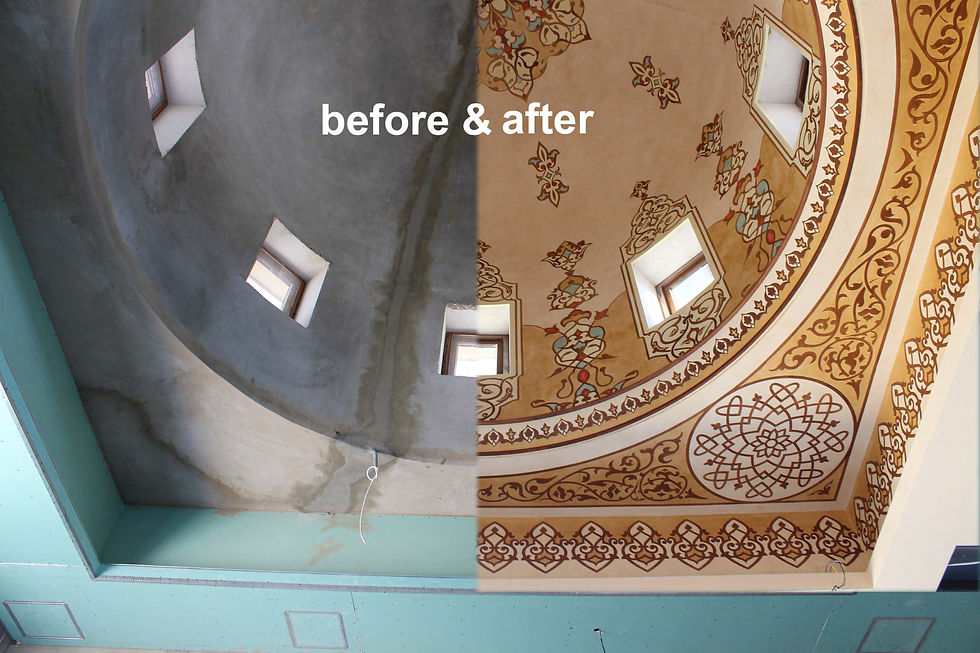
At a certain time in mega-mosques in the Middle East, I had 35 helpers, many of them volunteers with different skills helping to bring the dreams of a community to life. Here in the US, I am a one-man-show. I have the help of a graphic designer who transforms my sketches into digital files to enlarge them and transform them to fit the existing space, but the execution is all on me. Usually, a 1500 square foot dome takes one month to complete, working 10 hours a day, including on weekends.
Unfortunately, here in the US, I can't find dedicated artists who are interested in climbing scaffolds and working on large-scale art. The funny thing is that people ask me, “Did you paint and do that art by yourself? Aren't there any kind of machines that can print on domes?” To my knowledge, there is still no AI interference in creating detailed and balanced art and there are no machines that can print art on curved dome surfaces. I'm concerned that this profession might not have future dedicated artists to continue this centuries old profession.

"I'm concerned that this profession might not have future dedicated artists to continue this centuries old profession."
-Harout Bastajian
Your work creating monumental requires intense physical endurance, working in awkward positions for extended periods, spending hours at a time atop towering scaffolding and the inability to see the final result during production. What prepared you to not fear heights and to be able to trust your calculations and sketches implicitly until you can step back at its completion and view its transcendent impact as a whole?
Harout: All my life art was my happy place; but I generally disliked the lifestyle of artists. I loved the idea of living a life of adventure and thrill. I was very into extreme sports like cross-country skiing, competitive skiing, skin diving, cycling, and paragliding (I won the Middle East paragliding championship in 1997). In cliff climbing, I received the Golden Carabiner Award from a French mountaineering association. I climbed some peaks in the Himalayas, and hiked to the top of Kilimanjaro. I also competed in triathlons, and won the Red Bull Mount Lebanon competition.
For me the thrill of height was fun, and this gave me an advantage over other artists. But being an athlete was not enough to become a successful artist. This took both academic study and extensive field practice. Sitting down at a table and doing sketches and samples is one thing, and executing those sketches on a huge dome is another thing. I wasn't drawing some mural on a ceiling, where I could climb down the ladder, push it to the side, take a look, and go back up to make some corrections. On a dome, I had one chance to do everything right and then wait for the scaffold to come down and see the results. This is where knowledge, experience and confidence pay off. I don't have a choice, other than to do my studies well and take the exam with the mindset of scoring as high as I can.
Large-scale art requires intense physical endurance. I love my profession and working more than 10 hours a day, and dreaming of the next day's work while sleeping. I wake up so happy for a day of intense work, which brings me deep pleasure.
" I love my profession and working more than 10 hours a day, and dreaming of the next day's work while sleeping."

Can you share with us what you are working on artistically at this time and what you have coming up?
Harout: For the last two months, I have been working on two mosques in Dearborn, Michigan, while preparing the studies for several future mosque and church projects. I have already completed three domes in these mosques, and have now moved to the lower area doing calligraphy and ornamentation. I have to complete both mosques in one month, to have them ready for the month of Ramadan. Below are photos of the domes.
Top to bottom:
-A dome at Islamic Institute of America, Dearborn, MI, USA
-A dome at Islamic Institute of Knowledge, Dearborn, MI, USA
-A dome at Islamic Institute of America, Dearborn, MI, USA
Watch an extensive interview with Harout Bastajian on the Not From Here podcast (1 hr 19 min in length):


This blog was an interesting read, especially because the information is presented in a simple and understandable way. While researching related online entertainment topics, I also came across jaya9. Exploring different sources can be useful for understanding available features and finding information that matches your personal interests.
I keep the Infovayb web resource among the sites I browse occasionally. It combines practical advice with lighter and more entertaining themes.
Якщо хочеться знайти ресурс, де серйозні життєві питання сусідять із легким пізнавальним контентом, можна звернути увагу на lifehata. Сайт охоплює теми взаємин, свят, побуту, народних уявлень, сновидінь і повсякденного спілкування, тому кожен розділ має власний характер і може бути корисним у різних ситуаціях.
Мені подобається формат ресурсів, де після однієї корисної статті можна знайти ще кілька матеріалів на зовсім інші теми. На Infosaray саме така структура, адже сайт поєднує побутові, сімейні, фінансові та технологічні напрямки.
Для тих, хто хоче мати під рукою універсальний інформаційний ресурс, може підійти poradka. Сайт охоплює побутові питання, самопочуття, зовнішність, техніку та відпочинок, тому його можна використовувати і для пошуку конкретної відповіді, і просто для корисного читання.