


ARTIST SPOTLIGHT - "Art is Healing"

An interview with South Sudanese artist Santo Makoi.
In Cairo, Egypt, CARAVAN's President, Paul G. Chandler, had the joy of spending time with Santo Makoi, a remarkable South Sudanese artist and art educator, who is also a political refugee, affectionately known by many Sudanese as “Santo the Great” and “Santo the Teacher.” His life story and his passion for using art to bring healing to Sudanese refugee children, both in Sudan and in Egypt, is profoundly inspirational. He embodies the power of art to bring wholeness to individuals and harmony to communities.

"I believe that color brings life and that art is healing."
-Santo Makoi, South Sudanese artist

Santo Makoi is a South Sudanese artist based in Cairo, Egypt. He studied at the College of Fine and Applied Art at the Sudan University of Science and Technology (SUST), obtaining a B.A. in Fine Arts. A political refugee in Egypt, he is affectionately known to many as "Santo the Great" and "Santo the Teacher." Prior to residing in Cairo, he worked with various NGOs in both the Republic of Sudan (War Child) and the Republic of South Sudan (ROOTS), teaching art to displaced children. In Cairo, in addition to his artistic career, he continues to teach art to Sudanese refugee children and also assists Tukul Crafts, a fairtrade screen-printing and textile nonprofit that employs and empowers displaced Sudanese by providing a platform to create unique, tailor-made products using traditional African designs. His art studio is in the crypt of All Saints' Cathedral in Cairo.
For more information:
-Instagram:@santo_makoi
________________________

Can you tell us about your childhood in Sudan and what brought you to Egypt as a political refugee?
Santo: I am from the Dinka tribe, and grew up in the town of Wau in what is now South Sudan. It was during the time when northern Sudan and southern Sudan were fighting but still united. When I was 9 years old, I escaped my home, which was not a good environment, and jumped on a train and went to the capital city of Khartoum in the north. I was a child, and I went by myself, without any family. I found a Catholic church that had been founded by Italian priests known as the Comboni Brothers. They had compassion for me and let me live at their school, a Comboni mission school. I was the only student who lived at the school. They gave me a place to stay and gave me food and took care of me. I was able to go to elementary school and then secondary school there.
After secondary school, I applied to the College of Fine and Applied Art at the Sudan University of Science and Technology (SUST) to develop my passion for art. While I was studying there, I was encouraged to apply for a philosophy of law program in India, which I did and studied in India for three years, until tension between the Sudanese and Indian governments forced Sudanese students to leave the country. I then returned to Khartoum and finished my studies there, graduating with a B.A. in Fine Arts.

Then in 2011, after years of fighting between the north and south areas of Sudan, the country was officially divided and South Sudan became its own country. I was encouraged to go back to South Sudan, to our capital city of Juba, and secure my South Sudanese identity there, which I did. I became part of a cultural NGO there called ROOTS, and I was the head of their art gallery, the first gallery in the city of Juba.
I produced a lot of art and I became quite known in the international community. There were many foreigners working in development there at the time, such as from NGOs like UNICEF. My relationship with the foreigners made the government security forces suspicious of me, and one day I was suddenly arrested and put in their security jail. I was there for three months, and they tortured me repeatedly as they tried to prove I was associated with rebel forces subversive to the government because of my contact with foreigners through my art work. I went through a very difficult time.
After three months, I was released for a short while. Then one night I was picked up in a dark SUV and taken to a remote place, beaten, and abandoned. I didn't know where I was, but I could hear a bell ringing, a church bell like I remembered from my time with the Comboni Brothers in Khartoum. It gave me hope. And I was rescued by the priests, and I got back home; but I knew I would not be safe for long.
One of my friends had become associated with the parliament in the new government of South Sudan. He knew of all the hardship I had experienced and he was able to help me get identity papers and a passport so I could fly to Cairo, Egypt, where I registered with the United Nations as a political refugee. Through Sudanese friends, who are also refugees in Egypt, I was introduced to All Saints’ Anglican Cathedral’s Sudanese congregation and I am now part of that community. I was also introduced to Tukul Crafts, an arts and crafts charity focused on economically assisting displaced Sudanese, and based in the cathedral’s crypt; that is where I now have my art studio.

"My story has a lot of pain in it, but I have been sustained through very hard times by God and the gift of art God gave me which is a constant source of peace and healing for me."
-Santo Makoi
How did you first get interested in art and what formative influences have shaped your life as an artist?
Santo: When I was young, my art was self-developed. I had a natural gift for art, which my school teachers recognized and encouraged. I won many prizes at school and was once given an award for illustrating the story of Daniele Comboni, who was an Italian Catholic missionary priest who served in Sudan and founded the Comboni order, and who secured the release from slavery of many Sudanese, giving them an education. The encouragement of the Comboni Brothers, who were my teachers, inspired me to develop my natural gift for art.

There is a deep sense of pride in the way you portray your South Sudanese heritage, from the way in which you paint animals, like cattle, to the way in which you honor the strength of women. What inspires you to share these important cultural stories?
Santo: I am very proud of my culture. It is deeply rooted in our people’s understanding of the village community and what we value, which includes the cattle we herd. I am very much a storyteller and I tell stories through my art. I want others to see and understand that joy, and the harmony and spirit of my culture. It is a story of beauty that my culture has given me.
I love observing the details of life and of people. I notice what people look like and what they are wearing, if one person is taller than another, and even if a dog is present; the small details of life matter. Sometimes I go to the market and watch women selling fruit, exchanging money, children running around, and maybe a donkey walking by. Then I do some sketches before I go back home to paint that story.
I work to create an atmosphere of joy in the stories that I tell through my art. Focusing on painting the most beautiful aspects of my culture has been a gift of emotional healing for me, which I communicate best visually.

Can you tell us about the use of various mediums in your artwork?
Santo: I often paint using acrylics and sometimes I paint with watercolors. I also like to use other kinds of materials like coffee grounds and tea leaves, which can create interesting colors. Colors are very important to me. More recently, I have been doing collage work using a variety of African fabrics. It was teaching children that first inspired me to try collage artwork because I would bring magazines for them to cut and to create in that way. For me, this idea then evolved into a very distinct approach to collage, using African fabrics.

Santo Makoi, Wanna Dance?, mixed media - African fabric
The variety of ways in which you paint your skies brings emotion into your work. When you begin a painting, does the composition of your sky play an important role in telling its story?
Santo: To me, skies are a symbol of peace; they embody and reflect peace. When I am in the crypt of the cathedral, where I can’t see the sky, I don’t have the same feeling of peace as when I am outside. As soon as I go outside and can see the sky, I feel peace. Skies play a very important role in my work as a symbol of peace and calm.

You often paint musical instruments and dancing in artwork. Is this important to you?
Santo: Yes, it is very important to me. I love music and have taught myself to play the harmonica. You will see people making music throughout my artwork because music is essential to my culture. It is part of everyday life. Singing, dancing and instruments are also used in storytelling, rituals and village gatherings. For each of my paintings, I “title” the work by composing a musical piece with my harmonica.


In addition to creating your own art, you also teach art to children. How have you seen the process of creating art help students in healing ways?
Santo: When I was studying in the College of Fine and Applied Art in Khartoum, I worked with a European NGO called War Child. That gave me the opportunity to teach art to children in camps outside the big cities of Khartoum and Omdurman, from different tribes - Dinka, Nuer, Nuba, etc. I used the gift of art to give them hope and bring out their skills and creativity. Art is a really good form of therapy, psychologically and emotionally. I loved working with the children. I was known as “Santo the Teacher.” When I eventually went back to the capital city of Juba in South Sudan, I was known by a lot of people because many of these children had also returned from the north.
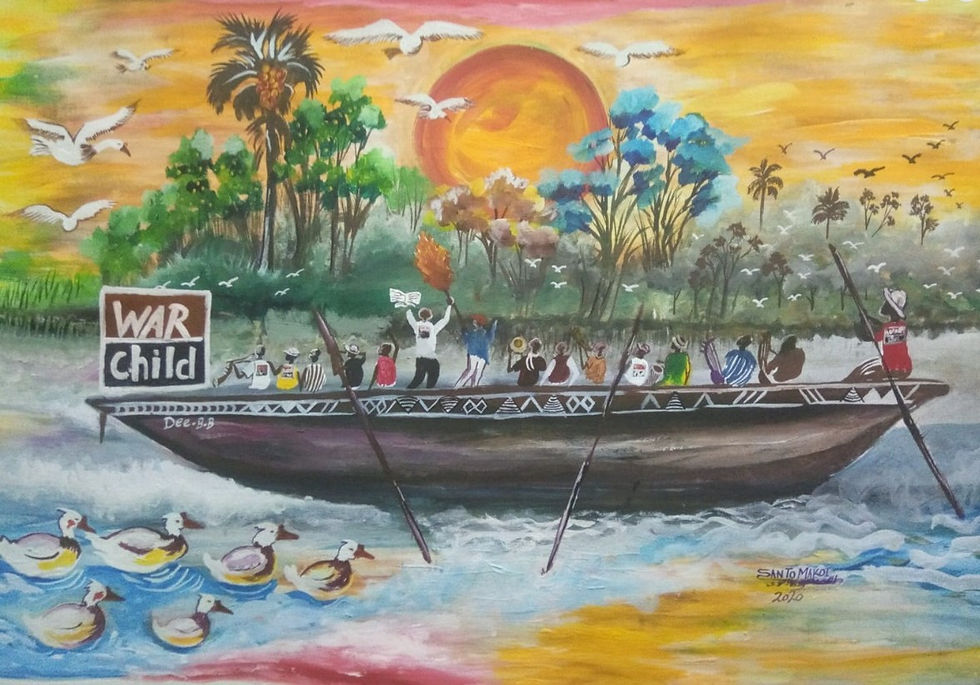
In Egypt I now work with two types of displaced children, refugees: those that are physically disabled or emotionally harmed. When I teach the children who are physically disabled to create art, I see their hand and eye coordination improve a lot. For the children who have been harmed emotionally, as they use different colors in their artwork, I see tremendous inner healing in them. They use greens and reds and yellows and blues and oranges to say things that are inside of them. Creating art can be very healing for refugee children who are emotionally wounded. I have found that they are often very drained afterwards. They want to sleep, they want to eat, and they're tired because of all that has come out of them through their creative work. I have a passion to improve people’s lives through art.

One special life memory I have was when I graduated from the College of Fine and Applied Art in Khartoum. Because I had been teaching children in camps, instead of receiving gifts of flowers or balloons to celebrate, I was given the gift of dozens and dozens and dozens of joyful children surrounding me, grabbing on to me, and not letting go. It was the deepest and most wonderful celebration I could ever have been given.

What do you hope to give to the younger generation through your teaching?
Santo: I want to help these children develop their own art skills, to encourage their confidence, and give them hope, and help build their character to prepare them for a good future. I believe that color brings life and that art is healing.

Your work is deeply rooted in your own life experience. What message do you hope others take away from your art?
Santo: Through my art, I want to communicate peace and harmony. I hope people experience that when they see my artwork, in addition to the beauty of my culture. I want people to experience that art is healing. That message is continuously influencing my own life. Art is a constant and God is a constant to me.

_______________________________________
Santo Makoi, Masks and Faces


The writing style here makes the article easy to follow from beginning to end. After reading it, I became interested in exploring some connected information and found jaya9. It is interesting when a useful blog introduces readers to other resources that they can explore independently
Classic Bead 16 action! Jump, capture, and dominate the traditional board game of skill and strategy.
The Cairo focus and CARAVAN’s “Art is Healing” message make this spotlight especially moving—such a thoughtful reminder of art’s power in community. I’ve been exploring resources on art and wellbeing using https://transcribe-audio-to-text.pro/mp3-audio-to-text
I love how the Cairo spotlight connects art with healing and creative engagement—such a meaningful reminder of art’s power across communities. I’ve been exploring similar projects through https://vidu-ai.pro
The Cairo setting and “Art is Healing” theme make this spotlight feel especially meaningful—what a beautiful reminder of art’s power to connect and restore. I’ve been using https://topazlabs.site