


ARTIST SPOTLIGHT - "Telling Visual Stories of Identity and Resilience"

An interview with noted Aaniiih (Gros Ventre) artist Sean Falcon Chandler
CARAVAN’s president, Paul G. Chandler, had the honor of interviewing noted Aaniiih (Gros Ventre) artist Sean Falcon Chandler (no relation) about his life, culture, and creative practice.

"I love what I do. I love contributing to the future of the education of my Indian community and whoever else that reaches. . . The fact that I see my students and the next generation with a desire to make themselves and their community better is what gives me hope."
-Sean Falcon Chandler, Aaniiih (Gros Ventre) artist

Sean Falcon Chandler is an enrolled member of the Aaniinen Nation (Gros Ventre), an artist, educator, scholar, and cultural advocate whose work explores Indigenous identity, ancestry, memory, and lived experience. His early artistic formation was shaped by his father, who taught him the traditional arts of his ancestors, including hide and tipi painting. Integrating those early teachings, Chandler developed his own contemporary visual language, addressing themes of identity, sovereignty, cultural survival, and lived experience.
Chandler is the President of Aaniiih Nakoda College on the Fort Belknap Indian Reservation in Montana and also teaches Aaniiih language to children in the college’s White Clay Immersion School. He holds degrees in Art, Native American Studies, and Educational Leadership, including a doctorate from the University of Montana, where his dissertation explored “The Identity of Upholding Indigenous Lifeways.” His work has received significant recognition, including the 2023 Eiteljorg Contemporary Art Fellowship, and is held in the collections of numerous noted art spaces, such as the Minneapolis Institute of Art, Yellowstone Art Museum, Missoula Art Museum, and Eiteljorg Museum.
For more information:
-Instagram: @niithuwaak
-Website: https://seanchandlerart.com
-Video: Fellow at Eiteljorg Museum
________________________

Can you tell us about how you grew up, and who and what influenced you to become an artist?
Sean: I grew up in an eastern Montana town called Glendive in the 1970s and 80s. My family was basically the only American Indian family in the town during those years, so of course, I was the only Indian in my class most of my years. Watching my father paint designs in a traditional way on a tipi started my mind going in that art direction, but in the 8th grade, I discovered that I may have had something of a real desire to be an artist. At that time, I was exposed to different types of media and styles, and I felt that I had some kind of art ability which gave me confidence—not just a confidence to have a career as an artist, but a confidence that I could be something in life that made me like life.

You have spoken about the influence of your parents on your life and artistic journey. Your father taught you traditional Aaniiih arts, including Buffalo hide and tipi painting. What did he teach you about art that went beyond technique—and what did your mother’s teaching about being a “free” human being come to mean to you?
Sean: Beyond the technique, my father taught me to take pride in what I create and do my best. I recall one time when I knew I didn’t really give a good quality effort to some artwork (I don’t remember what), he came along and looked at it and I knew he’d pick up on that, and he said, “Are you proud of that?” Haha, I couldn’t fool him. There would be a similar experience to that in college, in one of my painting classes; one of my favorite respected professors called me out in the way my dad did. My father also taught me that my artwork should mean something - good or bad or in between - or maybe tell some kind of story - but that it should be me or my own expression.
When my mother taught me this concept of being “free,” I didn’t quite know what she was lecturing me about; I knew that it was something of importance but I couldn’t articulate the true meaning of it until years later when in my 40s. My mom used to work at Dawson College in Glendive, where she had opportunities to inform that particular community about American Indian issues, culture, etc. Just like my father, she would reinforce my pride in my Aaniiih identity. When I was about 5 years old, right before one of the basketball games, she lectured me about the protocol at the beginning of a game; in particular, the playing of the National Anthem. She said, “now before the game starts, they will play the National Anthem, so make sure you take your hat off (I always wore a baseball hat, usually Yankees) and stand while it is playing. Keep in mind that you are honoring your people that have fought for this land, you have many grandfathers that have been servicemen, even your own father…but more than that, this land is still ours, we did not lose it and we are made from this earth. Also, people will put their hands on their hearts, but you, do not put your hand on your heart, because it means freedom, and we are not free - Indians are not free.”

I shook my head acting like I could articulate the meaning of everything she said. I knew it was important and I felt so much pride in who I am, an Aaniiih, an Indian; and for some reason, I also felt proud of not being free. I nodded my head in understanding and I said “yeah, got it” with confidence, but at that age I couldn’t explain to you why I understood.
It would take up to 40 years of my own life experiences before I could figure it out.
How have the experiences and wisdom of your ancestors shaped who you are today?
Sean: My ancestors have a lot to do with who I am today. If they had not strategized for survival, I wouldn’t be alive today. The U.S. motto used during the time of my ancestors of the 1800s was “kill the Indian, save the man.”
A couple of main points my father lectured me on, which were handed down to him by his grandfather and beyond, were to be prosperous and generous. I think that that’s how I’ve tried to carry myself; to work hard in whatever I have done, whether it was working towards an education, or employment in UPS, or at Aaniiih Nakoda College in order to be able to support myself and my family. At the same time, with that prosperity I should be generous with whatever I have to help others; that could be in terms of giving of material things or even time, listening, counseling and so forth. That philosophy helped me achieve a doctorate, it helped me become an American Indian Studies Instructor, it helped me become a president of a tribal college, and it has helped me become an artist.
With these Aaniiih way of life teachings, trauma was handed down too. I know that has shaped me in certain ways. Sure, I did not directly experience the most horrible experiences that they had gone through – the slaughtering to almost extinction of buffalo, foreign diseases, massacres, boarding schools, but I carry elements of their direct trauma within my DNA, my soul, my mind.
The positive lectures and examples of my parents pulled me through and helped me strive to become prosperous and generous.

"The Indian boarding school educational system. Holding him back while the rest have the freedom to advance. A system that allowed him to hand in the same assignment year after year about the book, The Black Stallion. Somehow through it all while holding onto his grandfather’s teachings, he becomes prosperous and generous."
You describe your art as containing “stories within stories.” Your paintings have a distinctive visual language of symbols, figures, patterns, and color. How do these elements come together for you to tell those stories?
Sean: As I develop my paintings, somewhere along the way a general meaning comes around, or maybe it doesn’t, but I know something is there in a larger context. It’s when I add little snapshots of my life or my parents’ lives or my ancestors’ lives, that the story tells itself.
The figures could be happy, sad, angry, or in chaos, or be all at the same time. In a painting like “When We Used to Be,” there is a big buffalo figure and within it are little figures - kind of spiritual, kind of ghost-like, kind of dark - just waiting there each in their own little section. But then outside of the buffalo is nothing but chaos, more figures, starving for something they don’t know about, or even not knowing they are starving. They are waiting in line for anything - in line for food, in line to use the outhouse, in line to use a toilet that flushes, in line for success maybe. But the overall meaning is that everything the buffalo is about, is what we were about - mentally, physically, spiritually….when we used to be…when we used to be ourselves…when we used to define ourselves.

"Having the knowledge and abilities before it became necessary to survive. All of the language, stories, history, lessons, lifeways that empowered a people to be able to prosper and be generous to each other. All contained within and without this one animal/creature/being. A living mode before survival mode."
When you are creating, what happens within you? How do you experience art as a connection to something deeper within yourself, to your ancestors, or to something beyond yourself, such as the transcendent?
Sean: As much as my art seems to be on the dark side, somber or sad, there is humor within as well. I have tried to create with all different kinds of emotions. I feel that I can paint my best when I’m angry or relatively happy. I’ve tried to paint when I’m emotionally low but I just can’t, no desire. So, I don’t know if painting takes me to a better emotional state of being right in the moment. I do know that it could take me to a lower emotional state; it doesn’t always happen but it does happen.
I definitely feel a connection when I paint my own experience just as my ancestors painted their own experiences. Even though I live in a different timeline than them, I’ve tried to apply the things I’ve experienced or felt just as they might have when they created.
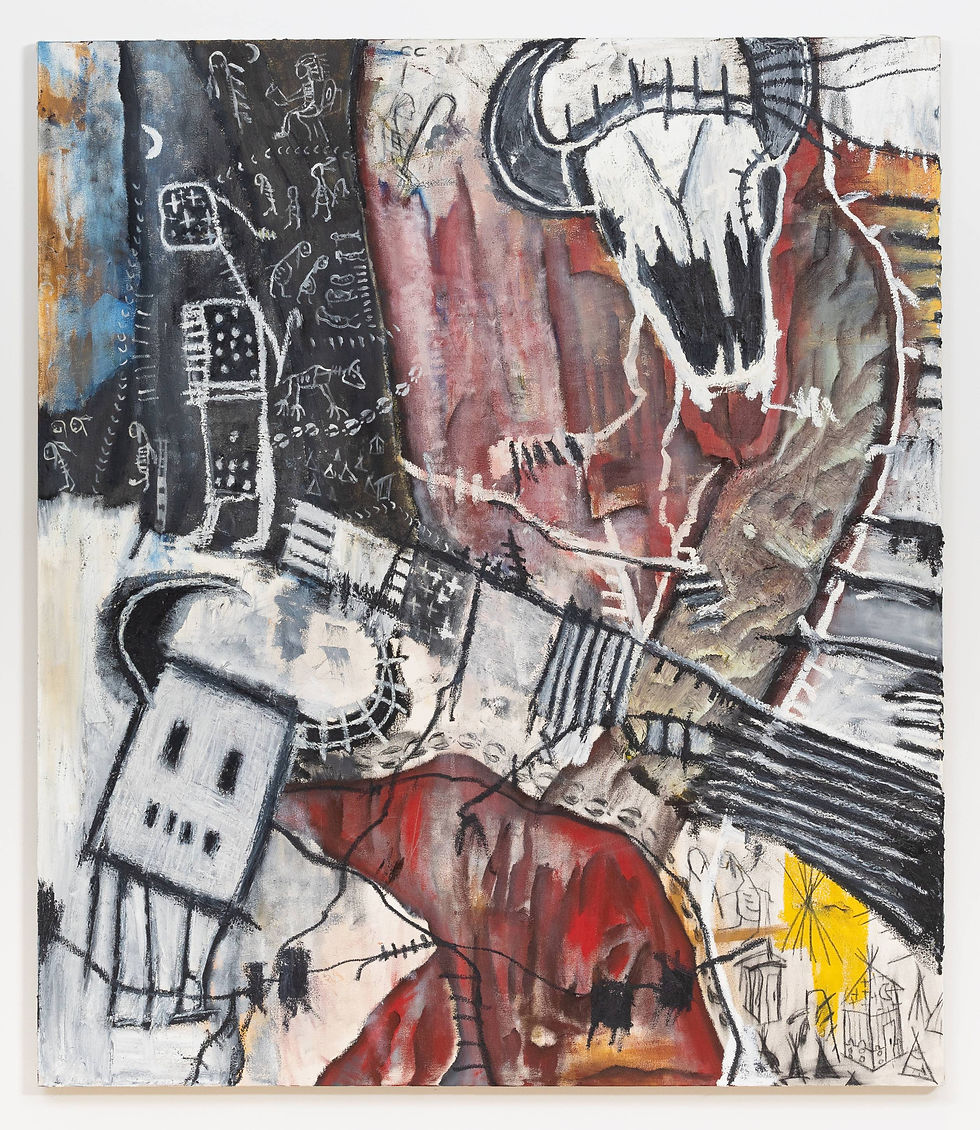
You speak about a search for wholeness that may never fully exist, and about the many pieces—humor, loneliness, identity, contradiction, and even empty spaces—that make up the whole. What has that search for wholeness taught you about yourself and about being human?
Sean: I would say that search and desire for wholeness has taught me that it takes a lot of time and patience and I’ve accepted that it just may not happen, and that’s ok. As long as I know what I’m doing is fine, it’s not hurting anyone, except maybe myself (haha). Also being human, mistakes happen all the time and it’s ok to embrace those mistakes. I remember once when I was working toward my doctorate, I confided in my dad that I felt like I was going to fail and I didn’t know what to do. He immediately said, “Hey that’s ok! I’ve failed my whole life and I did ok with my life!” After he said that, a weight was lifted from me. Eventually I would complete my doctoral program, but I’m sure I couldn’t have accomplished that or anything else later on without the strength of that little statement of his.
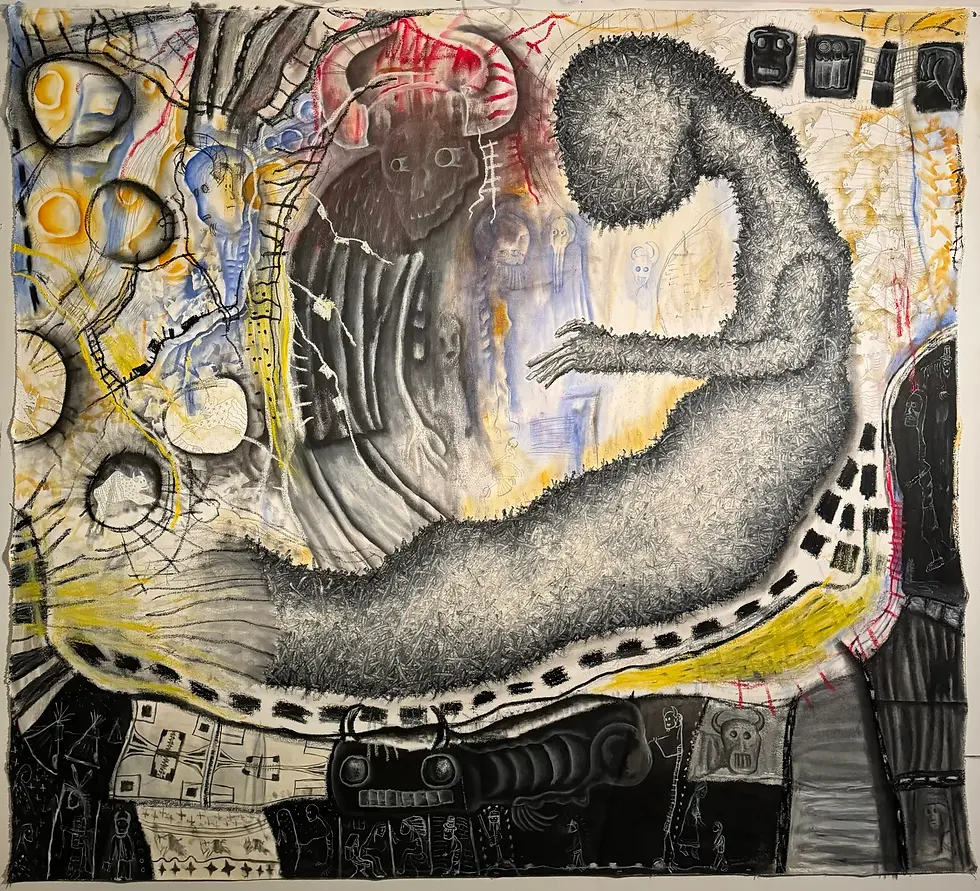
You have spoken about the tension between how Indigenous life is understood from within and how it is defined by others. How has that tension shaped your own understanding of identity—and your work as an artist?
Sean: I think it has made me maneuver the different situations that I am in. There are times that I don’t have to explain myself and then there are times that I have to give a big lecture. I am fortunate to have had my Aaniiih identity empowered by my parents in my homelife. With that strength, I am able to use that as a foundation to express myself as an artist.

You stepped away from making art for more than a decade while pursuing other work and responsibilities. When you returned, what was different about your work—and about you as an artist?
Sean: After the break, I had more vigor to be an artist, but I was also fearful. I felt like I had forgotten everything that I was about - as an artist. Then one day I put it in my mind and heart that I should just go with the flow and see what happens. After that, I remembered everything that I was about up to the time when I had quit art in 2002. I also feel that I am more “loose” in my painting. I feel like up to 2002, I was in a closed-in spot locating my own voice. Plus, I was younger and maybe didn’t have as much confidence. After I “un-retired” I just didn’t care anymore. As long as I was satisfied with what I painted or created, then that was it, this art is for me. The work that I do in my education work and responsibilities is for me too but it’s more for others, which of course I don’t mind. I love what I do, I love contributing to the future of the education of my Indian community and whoever else that reaches.

Can you share with us what you are working on artistically at this time?
Sean: Right now, I am trying to formulate and articulate a big project that will speak of resistance and resilience. It will require me to visit significant sites throughout the historical homelands of my Aaniiih ancestors. These are places of battles, massacres, buffalo sites, spiritual sites, historical sites, and so on. They are also places that I have lived that are significant to my own personal life. I will document these places with stories, photos, short video and audio. Then I will create paintings, installation, etc. I want this exhibit to be a historical document of my identity.

As an educator and president of a tribal college, you have devoted much of your life to honoring Indigenous lifeways, identity, and wisdom. When you look at your students and the next generation, what gives you hope?
Sean: The fact that I see my students and the next generation with a desire to make themselves and their community better is what gives me hope. When I see them learn their language, their identity and become proud and walk with a different confidence than they had before they set foot on the Aaniiih Nakoda College campus, that puts me in a positive place, especially if they are doing what they want, and if they are free and feel free to be prosperous and generous.
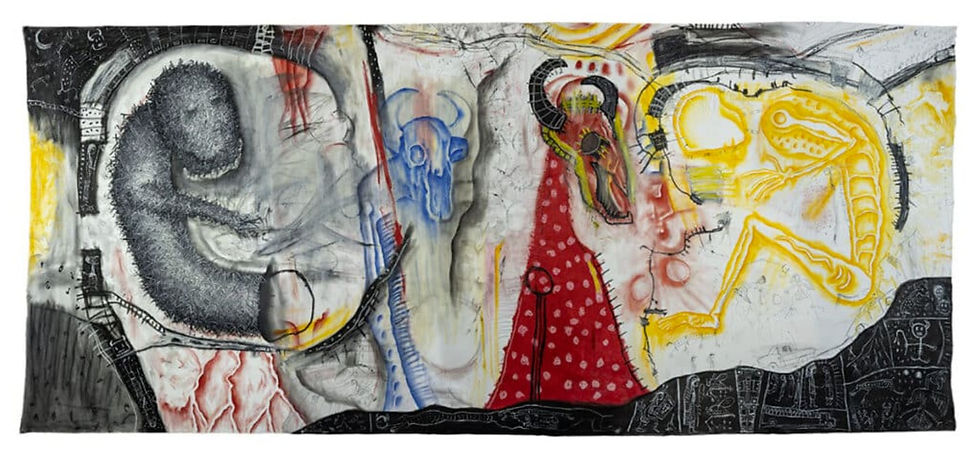
L to R:
St. Aloysius, 2022, Oil, oil paint stick, charcoal on canvas, 48” x 72” in
The Buffalo’s Bible, 2020, Oil, oil paint stick, pencil on canvas, 40" x 50" in
____________________________________


You never know what is waiting around the corner in Scary Teacher 3D, especially when Miss T is somewhere nearby.